



15 FEB 2021
Experts believe that France’s nuclear past in Algeria should no longer remain buried deep in the sand.
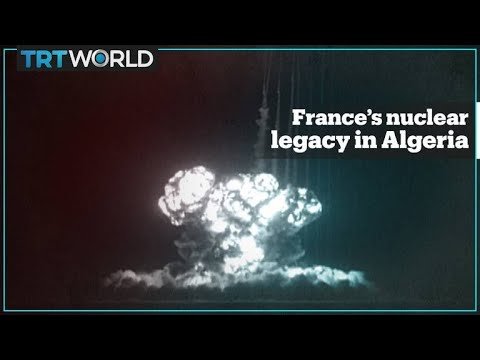
On the morning of 13 February 1960, France tested its first nuclear bomb called “Gerboise Bleue” (Blue Jerboa) in the Tanezrouft area, a portion of the Sahara that straddles Algeria and Mali, some 30 miles south of Reggane.
Gerboise Bleue had a blast capacity of 70 kilotons, or more than four times the strength of Little Boy, the US nuke which was dropped on Hiroshima at the end of World War II.
At that time, the French authorities claimed that the tests were taking place in uninhabited and deserted areas. However, it was later revealed that thousands of people were living at the sites where France was testing its nukes.
Algerians living in those regions were not warned properly after Paris’s mishandled nuclear bomb-testing campaign around the town of Reggane in 1960, which vitrified vast tracts of desert with heat and plutonium, leaving a legacy of uncontained radiation that is still crippling inhabitants.
According to France’s Ministry of Defence, the number of Algerians affected by testing was 27,000 but as per the figures provided by an Algerian nuclear physics professor, Abdul Kadhim al Aboudi, the number of people living there was up to 60,000.
Within two years, from 1960 to 1962, France tested four bombs above ground in Tanezrouft. The tests took place even after Algeria’s independence from France in 1962, which was achieved after an eight-year revolutionary war that left hundreds of thousands dead. Despite this, the French still maintained a military presence in the region, and tested 13 nuclear bombs in an underground facility beneath the Hoggar mountains, 643 km southeast of Reggane.
From 1960 to 1967, Paris carried out 17 atmospheric and underground nuclear tests in the Reggane and Hoggar regions. Nine of these were conducted after Algeria’s independence.
According to experts, nearly 42,000 Algerians were killed and “thousands irradiated” in those particular tests conducted by France between 1960 and 1967.
Modest estimates suggest that since 1960, at least 150,000 people have lived in, near or travelled through areas where France tested its atomic arms.
The damage done in Algeria began to come to light in the mid-1990s. A citizens’ organisation detected physiological harm often occurring among residents living near the test site as well as in nomads travelling across the Sahara.
Several reports also revealed that the radioactive plutonium used is responsible for high levels of skin cancer in southern Algeria, among many other illnesses.
The Evian Agreement
In 1962, the Algerian War for Independence came to an end, at least, on paper. The paper, simply entitled “Declarations Drawn up in Common Agreement,” was signed in a town on the French side of Lake Geneva better known for its bottled water than its role in diplomatic history: Evian-les-Bains.
Known as the Evian Accords, the settlement called for an immediate ceasefire and established the parameters for Algerian independence.
However, in accordance with a clause in the agreement, France was permitted to continue its testing programme until 1967. The Algerian government under Chadli Bendjedid’s presidency secretly granted the French permission to continue carrying out its tests at the B2-Namous site in Reggane until 1986.
When the French ultimately left Algeria, they buried a range of contaminated objects throughout the two areas – metal from remote-controlled towers that activated the bombs, engine parts from planes that flew into Gerboise Bleue’s mushroom cloud to gather radiation data and military-grade trucks placed in the blast radius to act as barometers of its power.
Because of the Saharan winds in the region, the sand covering these nuclear waste tombs were swept away. People living in southern Algeria were never informed by France about residual radiation hazards, and people began using contaminated items as resources.
Although Paris faced harsh criticism over its disregard for safe nuclear containment practices both internally and internationally, it has remained relatively quiet on the matter.
An Algerian nuclear energy expert, Ammar Mansouri, who previously described the tests as “the most despicable crimes perpetrated by colonial France in Algeria”, now demands that France – who signed a retroactive International Atomic Energy Association treaty on radioactive waste management in 1997 – face international law.
More than six decades after Gerboise Bleue was conducted, a report from the International Campaign to Abolish Nuclear Weapons (ICAN) recommended France to provide Algeria assistance in cleaning up the relevant sites.
As per the ICAN report: “From the beginning of nuclear tests, France set up a policy of burying all waste in the sand. Everything that may have been contaminated by radioactivity had to be buried.”
That included planes, tanks and other equipment. Worse still, radioactive materials were left out in the open, thereby exposing the population and the environment to assured danger.
The report also mentioned that since France had not been subjected to any obligation under the agreements it established with Algeria, it has never revealed the location or quantity of the buried waste.
The report said: “The nuclear past should no longer remain buried deep in the sand.”
The toxic aftermath of France’s atomic legacy
Residents of southern Algeria reported the strange rise in medical issues that first appeared during the 1970s and persist to the present day.
Babies born with atrophied limbs; liver, stomach and skin cancers; and blindness among those who witnessed the brutal nuclear flashes when the bombs were detonated. In Reggane, many were in the middle of their morning (fajr) prayers when one detonation took place.
Those who survived must deal with higher incidences of cancer, birth defects, and genetic mutations for generations. If the sources of radiation are still invisibly there, the danger remains rife and present amid them all.
More than half a century later, France has yet to shoulder full responsibility for its dark colonial legacy in Algeria.
Just last month, Paris announced that there will be no apology for colonisation and its activities that claimed millions of lives during its 132-year occupation of Algeria.
