



Source: kassaman-times.com May 1, 2021
Algiers and Tamanrasset airports, African hubs (project delivered 2019-Alger, project underway Tam-Tam) Project cost: $800 million

Algiers airport is now the largest airport in Africa in terms of capacity (22 million passengers) thanks to the new terminal built in 2019. The objective of the authorities is to meet the strong tourist demand of Algerians as well as the foreign community but, above all, to capture a new clientele, that of tourists in stopover. Indeed, more and more people use airlines to reach Dakar, Kinshasa or Lagos. Air Algerie’s objective is to make this airport a strategic axis between Paris, London and Brussels to link with West and Central Africa. In 2028, a new extension will be delivered allowing to pass to more than 30 million passengers. The ongoing strategy to transform Algiers into an African hub could bring billions of dollars to the country. Let us not forget that Turkey and the United Arab Emirates have diversified their economies thanks to the hubs of Istanbul and Dubai, which have become gateways to Asia.
Despite the potential of Algiers, the authorities also want to create a second hub further south in Tamanrasset in order to transform the Algerian South into a gateway for the Sahel states. Voted in the Council of Ministers in October 2020, this regional airport coupled with the Trans-Saharan will play a dynamic role in the Algerian economy. By road and air, Algiers will be as close to Lagos as to Tunis.
Trans-Saharan Railway (delivered June 2021) Project cost: $5.2 billion

Considered as one of the biggest African projects, the long Algiers-Niamey-Lagos road launched at the end of the 1960s will become a reality in less than a month. Built in sections across the three countries, the last part located in Niger has just been completed by Cosider, the flagship of the Algerian construction industry. More than 4,000 km long, it is the result of a relentless policy of Algiers to realize the promise of Boumediene seeking to link Algeria to West Africa, particularly with Nigeria, the real economic and demographic engine of ECOWAS.
Part of this Trans-Saharan (2,400 km) will be four lanes to support the strong growth of vehicles and trucks travelling between Algeria and Niger. To better facilitate trade, which will increase significantly by June 2020, Algeria will open new border posts with Mali and Niger. Indeed, despite the fact that the Malian state is not involved in the project, this does not prevent this country from being impacted by this new “desert highway”.

The impact of this project will affect a large part of the Sahel as well as West Africa. Algiers will thus be directly connected to more than 400 million inhabitants. According to the Nigerian Society of Engineers (SNE), more than 10 million jobs could be created in all the impacted areas thanks to the circulation of goods and services, the development of infrastructures along this road, the creation of factories and companies in the region and the revival of agricultural production in the south of Niger and in the north of Nigeria. A good way, therefore, to put an end to deadly migration in the Sahel. Security will be a crucial issue in securing this route. Algeria’s military involvement, coordinated with Niger, Mali, Chad and Nigeria, will have to be strengthened. The trans-Saharan can also benefit from the future port of El Hamdania.
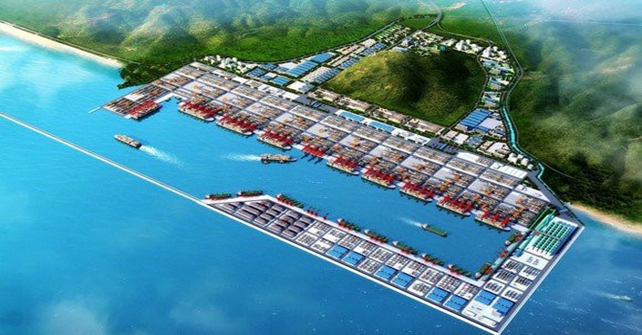
Port of El Hamdania (project delivered 2028, commissioning 2025) Project cost: $5-6 billion

A controversial project since its launch in 2015, the port of Cherchell was officially relaunched by the Council of Ministers on 28 February last. The economic revival operated in the 2000s showed that the ports of Algiers, Oran or Skikda were no longer able to receive containers or to store oil and gas products. The explosion of the port of Beirut in 2020 highlighted the danger of ports in urban cities. This port project will be, when fully commissioned, the largest in Africa with more than 25 million tonnes of goods per year.
With its 23 quays, the port of Cherchell will be directly connected to the East-West motorway and the Trans-Saharan. Thus, all the trade of the Sahel States, but also of a part of West Africa will pass directly through this port. Countries such as Mali, Niger, Chad, Burkina and Nigeria will be directly connected to the port thanks to the Algiers-Lagos highway. The financing of this major project will be ensured by the national investment fund (Algerian entity) and a long-term loan from the Exim Bank of China.
Tebessa phosphate mining (project delivered in 2022) Project cost: $6 billion

The latest major project launched under the presidency of Bouteflika, the Tebessa mining project is considered the largest phosphate investment project in the world today. Algeria has considerable reserves estimated at more than 2 billion tons. Phosphates are an essential mining product for agriculture and are used with natural gas to manufacture fertilizers. This project will allow Algeria to become a major producer and exporter of fertilizers in order to boost Algerian agricultural production estimated at more than 26 billion dollars, twice as much as that of Morocco.

The Algerian major Sonatrach, and the national mining group Asmidal will work hand in hand with Chinese companies on a 51/49 basis. The commissioning of this project will allow Algeria to increase its phosphate production from 2 to 10 million tons per year.
Ghar Djebilet Iron Mine, (Project to be delivered in 2025) Project cost: $2 billion

After several attempts by Algeria in the past to realize this major mining project, the state has just signed a memorandum of understanding in March 2021 for the exploitation of the iron mine located near Tindouf. With recoverable reserves of more than 2 billion tons, the Ghar Djebilet mine is considered one of the largest in the world. The exploitation contract is also shared under the 51/49 rule between the Algerian mining company FERAAL and a Chinese consortium. This project is vital for the Algerian economy, in particular to support the country’s industrial growth, which is increasingly driven by steel plants. It will also increase the exports of the Algerian steel mill for this decade. With this project, Algeria will become the Arab and African leader in the steel and metallurgical industry.
Renewable energy 2030 (project delivered within the decade, full commissioning 2035) Project cost: $5 billion minimum

Launched in 2012, the former Bouteflika administration had set a large and ambitious program of 22,000 MW by 2030 representing 27% of the country’s energy production. However, it must be noted that the project has never taken off despite a strong infatuation of the Algerian public opinion. The current Minister of Energy Transition, Chitour announced the launch of the first phase of the project with the 1000 MW program from June. Sonatrach and Sonelgaz are working hand in hand to achieve the objectives of the 22 000 MW project. By the end of the year, the first kWh of the solar plan will be produced initiating in a concrete way Algeria in the world of renewable energy.

It should be noted that our country has the largest solar potential in the world. Algeria even has the potential to fully support its electricity production through solar energy while exporting half of this unlimited resource! This project will also save gas and oil production up to 30% in order to strengthen exports and thus allow Algeria to continue to be a major exporter of gas and oil to Europe and Asia. The development of renewable energies in Algeria can generate several thousands of direct and indirect jobs, not to mention the consequences for research and development in areas such as the automotive industry, medical research, start-ups, etc.
Nobody can deny the economic potential of our country through its impressive natural resources. We still have the chance to make Algeria emerge at the level it deserves. For this, the decision-makers must translate these promises into action by respecting the deadlines they have set. If we achieve the objectives in 2030, Algeria will be a respected continental power and will be able to play a leading economic, political and security role on a par with South Korea, Brazil and India.
