



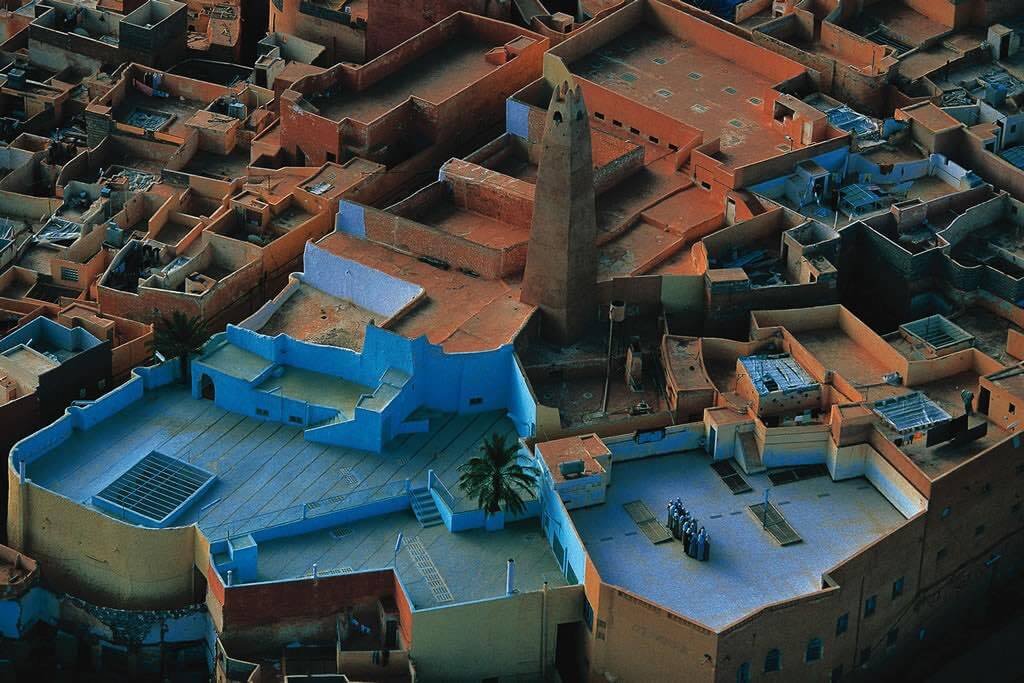
The M’zab valley located in the wilaya of Ghardaïa is a region in the north of the Algerian Sahara with an architecture and a community model deeply marked by the Ibadi rite.
Nearly 600 km south of Algiers stand the seven ksours of the M’zab valley, UNESCO world heritage since 1982.
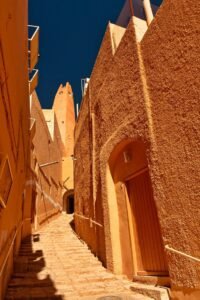
The presence of these fortified towns in the desert dates back to the fall of the Rostemid empire. Ibadi from the 10th century and the exile of the royal family in the region.
The M’zab Pentapolis includes the ksour of Tagherdait (Ghardaïa), At Bounour (Bounoura), Ate Izjen (Beni-Izguen), Tajnint (El Atteuf), Ate Mlichet (Melika), Ate Bergan (Berriane), and Ighraren ( Guerrara). Each city presents the model of almost identical minimalist houses organized in concentric circles around a mosque and a market.
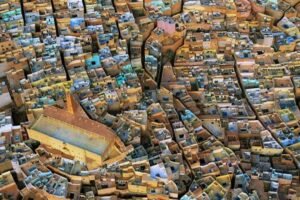
This urban planning model is not accidental, however. It draws its sources from Ibadism, one of the oldest Islamic schools and once mainstream in the medieval central Maghreb. Ibadism is then characterized by its vision of the practice of good as a fundamental religious principle, its promotion of equality between all and its community management of the affairs of the city.
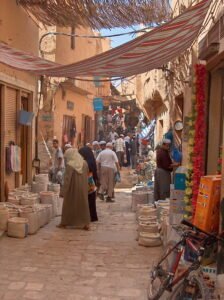
Thus, a council of wise men named Azzaba determines the modalities of life in society. The rules inherent in life in the M’zab include mutual aid through the concept of Touiza (volunteering for the common good) which allows the construction of houses for all citizens, or even equality in marriage with the setting up of a single group ceremony during a day of the year marked by festivities without distinction of social class.
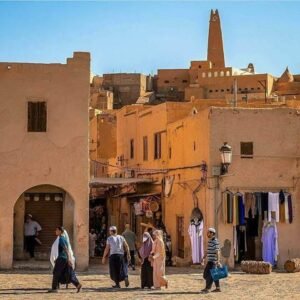
The vernacular town planning of the M’zab valley has the particularity of integrating the different functions of each building present within a coherent framework while respecting the social whole. The ksour adapt not only to the arid climate, to the location of the site with in particular a mosque present in the heart of the highest point of the place but also to the social conditions and beliefs of the inhabitants.
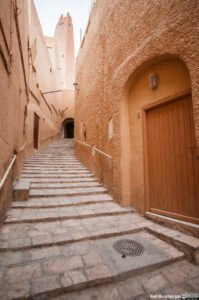
The M’zab Pentapolis has inspired many architects including Le Corbusier, Ricardo Bofill, François Pouillon, Frank Lloyd Wright and André Ravereau. The latter summed up the appeal of the site with his famous phrase:
The Mzab is prestigious without intention of prestige
Translated by Hope from nessahra.net
