



By Farid Alilat theafricareport.com
Just as Algeria and France are undertaking a joint effort to preserve the historical legacy of the Algerian War, a recently released book reveals details about the clandestine operations carried out by French intelligence services.
Targeted killings, clandestine operations, orchestrated eliminations and acts of sabotage: the French secret services used all sorts of spy games to take out National Liberation Front (FLN) leaders, lawyers committed to defending the independence cause and arms dealers during the Algerian War (1954-1962).
Released in an expanded paperback edition this past September, journalist Vincent Nouzille’s Les tueurs de la République : assassinats et opérations spéciales des services secrets (The Killers of the Republic: Assassinations and Special Operations of the French Secret Services) confronts the dark side of France’s counterespionage agency.
During a combat that lasted seven and a half years, nearly 200 people were reportedly assassinated as part of these operations, although this number is difficult to verify given their highly confidential nature.
Raymond Muelle, a member of the commando unit tasked with such operations and who himself took part in a number of killings, described the chain of command to the author as follows: “The homo [homocide] operations were directed by Matignon, the seat of the prime minister, which relayed instructions to the External Documentation and Counterespionage Service [SDECE]. But it was Jacques Foccart over at the Élysée who was calling the shots.”
A booby-trapped radio set airdropped in Aurès, Algeria
SDECE’s armed wing, the 11th Shock Parachutist Battalion, was deployed in Algeria shortly after the beginning of the war, in November 1954. One of the first missions it was tasked with was to take out Mostefa Ben Boualaïd, a founder of the FLN and insurgent leader in Aurès. In the spring of 1956, a member of the 11th unit was dispatched to this area, reputed to be impenetrable.
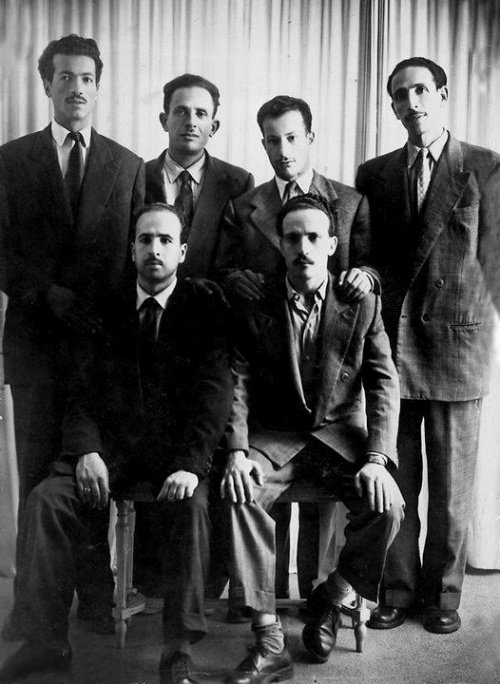
Ben Boulaid Mostefa
But how could the elusive Ben Boulaïd be reached? The 11th Shock Parachutist Battalion team decided to airdrop a radio set – one that had been booby-trapped in advance by operatives from SDECE’s Action Service – in the mountainous region where the rebel leader was based.
Picked up by members of the Maquis [Algerian guerrillas], the device was taken to Ben Boulaïd’s HQ. A few days later, while the revolution leader was trying to get the radio to work, the parcel exploded, killing him instantly along with two deputies.
This was the French secret services’ first major “homo” operation against the FLN and its supporters, both in Algeria and abroad. It was the harbinger of other stunts, as clandestine and spectacular as the first, to come.
A list of 30-odd names was drawn up with the approval of the Élysée and in coordination with Matignon and the SDECE. It included German and Swiss arms dealers, FLN lawyers, prominent foreign FLN supporters and Algerian authorities based out of Morocco, Tunisia and Europe.
Collateral damage
In the thick of the Algerian War, the French intelligence services’ primary targets were dealers and traffickers supplying the FLN with weapons and munitions. Three such men were hunted down for years with the express purpose of neutralising them.
A former Gestapo member based out of Yugoslavia, the German national Wilhelm Beisner sold weapons in the Arab world and divided his business dealings between Cairo, Damascus and Munich. The FLN was part of his customer portfolio and he oversaw the training of Algerian recruits in camps in Egypt.
When SDECE agents ordered him to suspend his business dealings, he did little to heed their warnings, referring to the threats as something out of a “bad novel”.
But the French secret agents weren’t fooling around. In June 1957, Action Service operatives planted an explosive device in Beisner’s Munich residence. He lost both legs in the attack, but miraculously survived after undergoing surgery.
Otto Schlüter almost had the same fate. On paper, this German citizen was an armourer for the State of Hamburg. But in the SDECE’s eyes, Schlüter was also a supplier of the Algerian Maquis. In September 1956, his office complex was bombed; one of his employees died in the explosion.
He continued to receive warnings after the attack, including a small wooden coffin with the following message inside: “Beware! Second and final warning. Immediately cease your foul business.”
On 3 June 1957, his Mercedes exploded as he entered the car alongside his mother and daughter. His mother was killed instantly and his daughter injured. He survived the attack with just minor injuries. One year later, he escaped another attempt on his life disguised as a car accident.
‘La Main Rouge’, an SDECE proxy
The German police were entrusted with the investigations into these mysterious attacks and groped in the dark for several months before the judiciary was able to name the guilty parties and backers.
In April 1959, the public prosecutor of Frankfurt openly accused the organisation “La Main Rouge” [The Red Hand] of being behind the attacks and made it clear that the terrorist group was presumably working with the French secret services.
Created in Morocco in the early 1950s with a membership supposedly comprising colons ultra [ultra-colonists], “La Main Rouge” was in reality an SDECE proxy. According to the German prosecutor, the organisation had carried out 10 attacks in Europe since 1956. Six were committed within the Federal Republic of Germany (West Germany), including one incident involving the murder of a young Kabylia-born lawyer.
A representative of the FLN in West Germany, the lawyer Ameziane Aït Ahcène was suspected of being part of an arms trafficking ring operating on German soil. On 5 November 1958, in Bonn, his car was sprayed with bullets. He would die a few months later as a result of his injuries, at the age of 28. Once again, the attack bore the mark of “La Main Rouge”.
Brothels and arms trafficking
Marcel Léopold made his fortune running brothels and opium dens, among other businesses, in China in the 1930s, before he returned home to Switzerland to work in the arms trade, selling weapons to the FLN.
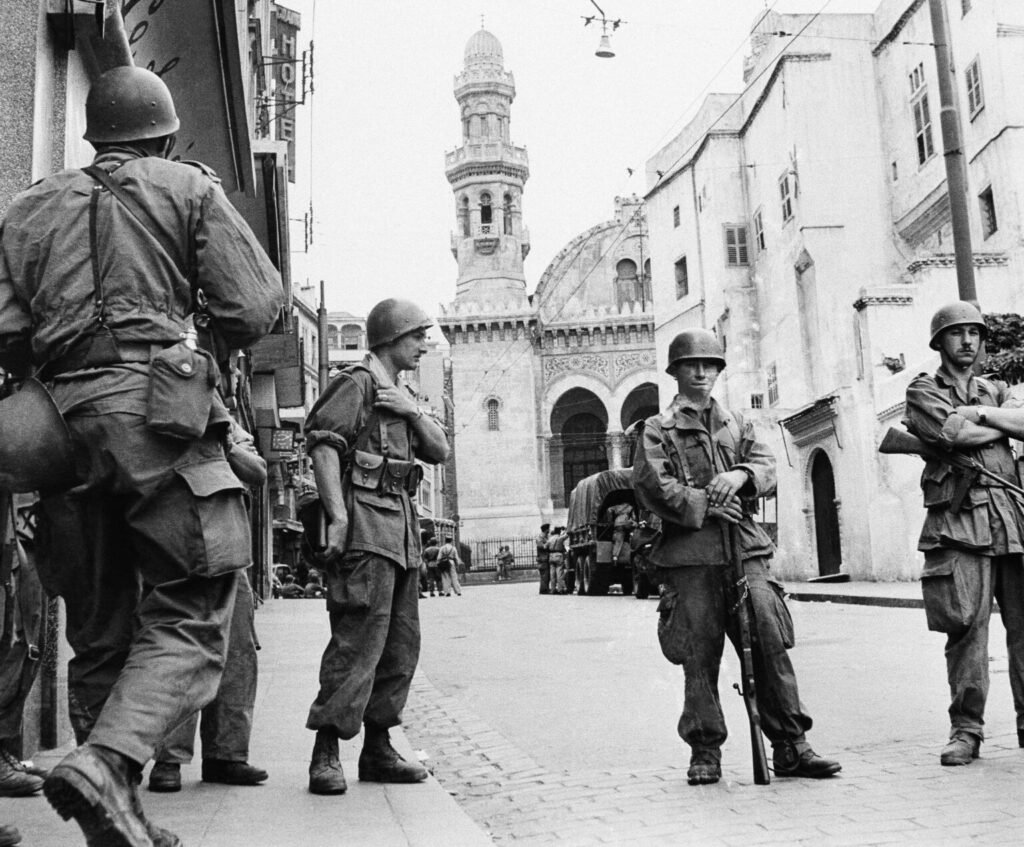
FILE – In this May 27, 1956 file photo, French troops seal off Algiers’ notorious casbah, 400-year-old teeming Arab quarter. French President Emmanuel Macron has formally recognized that the French state was responsible for the death of a dissident mathematician in Algeria in 1957, admitting for the first time the French military’s “system” of torture during Algeria’s independence war. (AP Photo)/XPAR101/18256476484078/MAY 27 1956 FILE PHOTO/1809131519
Nicknamed Captain Morris, Puchert got rich from cigarette smuggling before shifting over to the arms trade, transporting weapons via his small fleet of boats. One of his bases was none other than Morocco, which housed the top brass of the National Liberation Army (ALN) during the war.
Of course, Puchert ended up in the cross-hairs of the French secret services, who blew up four of his boats in Morocco, Germany and Belgium. But it wasn’t enough to scare Captain Morris.
Built like a nightclub bouncer, smarter than average and with a reputation as a daring, cutthroat businessman, Puchert was such an important figure in the arms trade that he attended a meeting in Tunis held in 1956 by Krim Belkacem, one of the most significant leaders of the Algerian Revolution, as he would later serve as chief negotiator of the March 1962 Évian Accords that brought an end to 132 years of French occupation of Algeria.
On 3 March 1959, Puchert’s Mercedes 190 exploded in Frankfurt, killing him instantly. SDECE operatives had planted a car bomb the previous day. One year before his murder, he received a coffin-shaped parcel as a warning. In 2006, 44 years after Algeria’s 1962 independence, Puchert’s remains were repatriated to Algeria where he was interred as a martyr. When he was alive, his dream was to lead Algeria’s merchant navy.
A hit list of lawyers
Arms dealers and traffickers weren’t the only targets on French secret agents’ hit list. A group of lawyers who were very active in France and supportive of the Algerian cause, including among its ranks Mourad Oussedik, Mohamed Ben Abdallah, Mokhtar Ould Aoudia and Jacques Vergès, was also in the sights of the French authorities.
The list of lawyers to monitor and kill off was drawn up by the head of the SDECE and signed off by Jacques Foccart, the secret mastermind behind General Charles de Gaulle’s Algeria policy who would serve as the “Mr Africa” of French presidents for decades.
Mokhtar Ould Aoudia, a student of the White Fathers and married to a Frenchwoman, was one of a number of distinguished lawyers representing FLN activists in France. Like other members of the group, he received several threats via letter with a brief promise: “YOU WILL DIE”. On 21 May 1959, a hit man entered Aoudia’s Paris office and shot him in the heart. The lawyers Oussedik and Ben Abdallah were also supposed to be taken out that night, but they managed to shake off the hitmen sent to slay them.
