



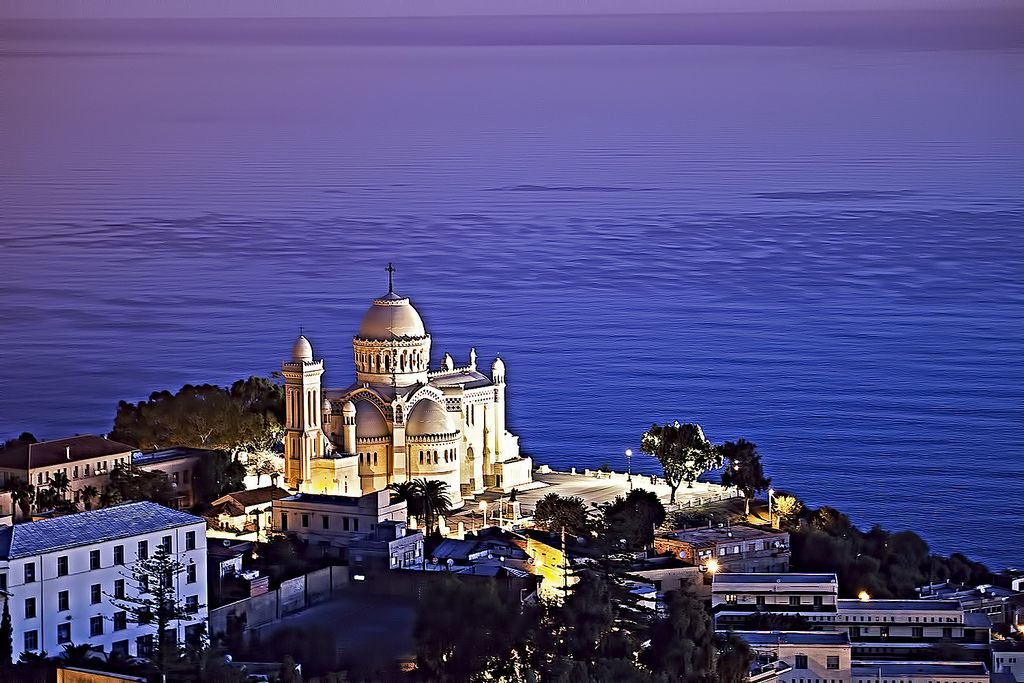
Algeria is home to two Catholic basilicas on its coast: the Notre-Dame d´Afrique basilica in Algiers, and the Saint Augustine basilica in Annaba.
A basilica is a privileged church in the Roman Catholic Church that has obtained an honorary title from the Pope, and which the faithful visit as part of a pilgrimage. The basilicas are considered among the most important Catholic buildings, with the exception of the cathedrals of the dioceses which are the main churches.
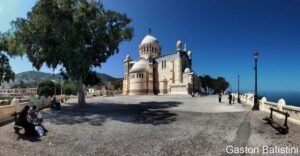
The Basilica of Our Lady of Africa
Located in the Bologhine district of Algiers, the Basilica of Our Lady of Africa, also nicknamed “Madame Africa”, stands on a promontory at a height of nearly 124 meters. Construction of the church began in 1858 and was completed in 1872 under the leadership of Mgr Pavy, a French Catholic bishop, who entrusted the work to Jean-Eugène Fromageau. The bishop, who died in 1866 before the work was completed, is buried in the choir of the building, which has the distinction of being oriented towards the southwest rather than the east.
The basilica obtained its honorary title in 1876 under the governance of Pope Pius IX and has been classified since 2012 on the list of Algerian cultural goods as a historical monument.
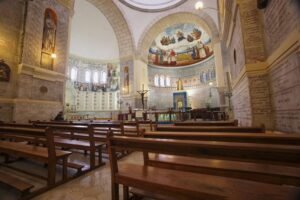
Notre-Dame d’Afrique has a Roman-Byzantine architectural style with two chapels, one of which is dedicated to Saint Augustine and which contains six ex-votos by Charles de Foucauld, while the second is dedicated to Saint Monique, mother of Saint Augustine, and which pays homage to the nineteen religious figures killed during the decade of violence of the 1990s in Algeria.
The decoration of the basilica contains many elements from Algerian craftsmanship such as ceramic works by Mohamed Boumehdi, or referring to the Christian past of the region through local religious figures. An inscription behind the altar contains the prayer:
Our Lady of Africa pray for us and for Muslims.
Saint Augustine basilica
Built on a hill, the Basilica of Saint Augustine is located in Annaba, in the northeast of Algeria. It is dedicated to Saint Augustine of Hippo (old name of the city), who was its bishop from 396, until his death in 430.
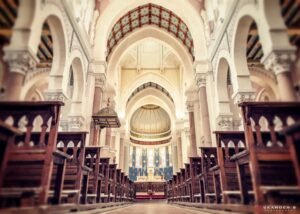
Work on the basilica began in 1881 and ended in 1900. The peculiarity of the building was that it housed an ulna of the saint and that it was also the site of the pro-cathedral, that is to say that it welcomes the bishop of the diocese of Constantine by acting as a temporary cathedral.
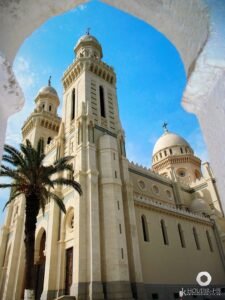
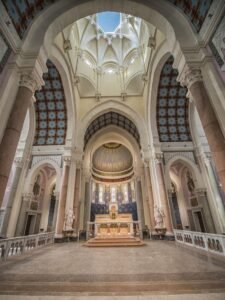
The basilica would be built not far from the ruins of the church where Saint Augustine served and where he died during the siege of the city by the vandal armies of King Genseric. A key figure in Christianity and philosophy, Augustine of Hippo was born in today’s Souk Ahras, the former Thagaste. One of the four Fathers of the Western Church was already Bishop of Hippo when he wrote his books Confessions, the City of God, and On the Trinity.
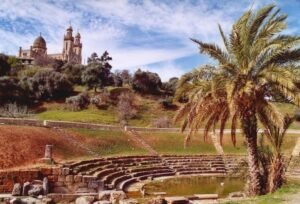
Photo: Sam, Saint Augustine Basilica and Hippo Ruins
Source : translated from https://www.thecasbahpost.com/les-basiliques-dalgerie/
