



Officially we begin the preparations eight days before the wedding night which almost always takes place the night of Thursday to Friday. For several days we bake cakes and roll couscous. All the neighbors come to the aid.
We start to issue the invitations – Es-sadan – orally at the very beginning of the week. The two families call on the matchmaker, a lady well-established in the homes, to pass on the invitations. The fathers of the newlyweds themselves invite their relatives and friends.
The days of t’arouis: these are the days preceding the wedding night
From the moment the marriage contract has been drawn up, the newlyweds should not see each other before the wedding night. They must each observe certain rules:
The young man must not see his parents or any elderly person who could encourage him to show them some modesty. However, after two or three days the father wants to see his son to make sure of his state of mind. The son is obliged to temporarily break this retreat and kiss his father’s forehead to reassure him and thank him. The suitor then resumes his retirement, surrounded by his friends who also act as an intermediary between him and his father.
The young girl should not show herself to her father or her brothers (unless they are younger than her). It is also hidden from the gaze of neighbors to ward off the evil eye. Both families protect the lovebirds from the evil eye or some evil spell. They monitor the facts and actions of relatives and neighbors.
The bride’s bath: the bride-to-be is taken to the hammam at least three times in order to put her in beauty before the wedding night.
On the eve of the wedding night, the entire hammam is reserved for this event, to which only relatives and two or three ladies who are friends of the family are invited, as well as two or three friends of the bride who are recognizable by their hair falling in braids or pulled back surrounded by a ribbon – qardoun.
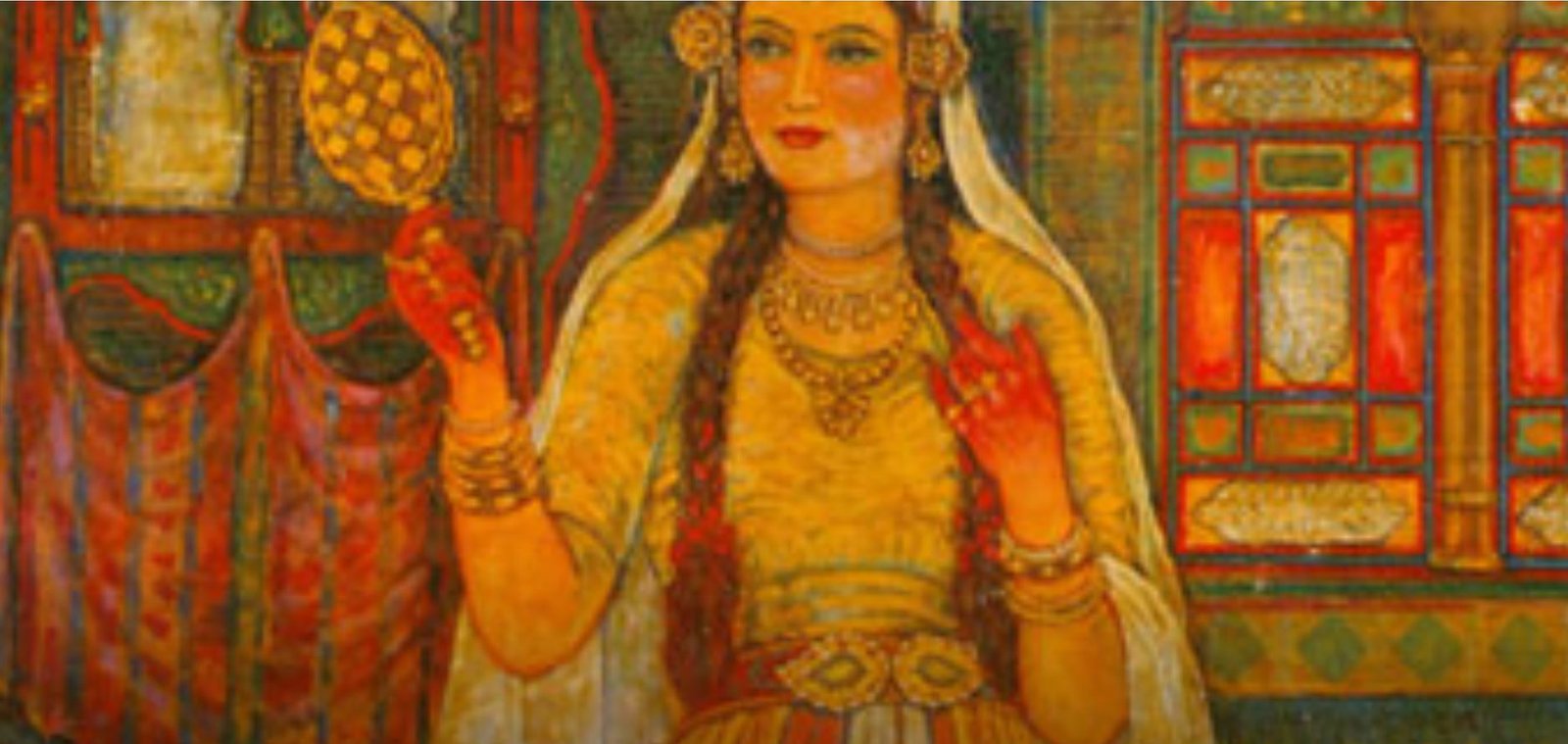
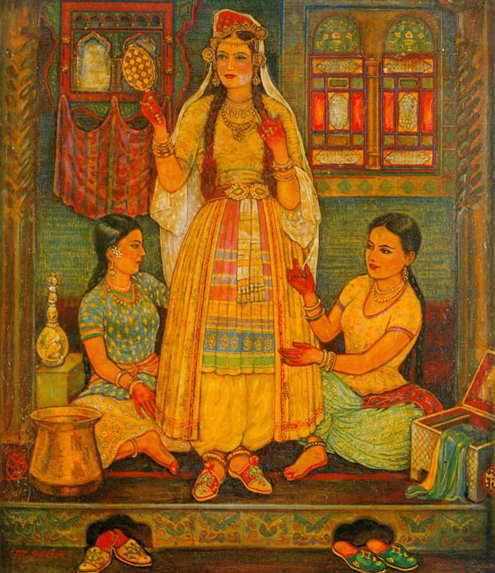
A whole procession of women, on foot, follows the bride. She is covered from head to foot with a long silk veil. No one should see his face. From the house of the young bride to the hammam we hear youyous and songs. Once there, the maachta and nadrat el hammam (the owner of the hammam) take care of her. It is a magical moment for the bride “the beautification bath” so she will be ready for the night of henna during which a kind of tattoo is done on her feet (up to the ankles) and on her arms ( up to the elbow).
The groom’s henna: the parents of the young groom organize the evening a few days before the wedding night, after salat el maghrib. The guests are not numerous (only relatives and a few friends). Music and youyous ring out, the meddah and his troop go around wasst edar playing the traditional zorna. The music lasts until late at night, sometimes even until dawn.
The young groom dines in his room with his friends. He then goes to West Dar for the henna break, wrapped in his burnous, his face completely hidden in his hood. A friend on the right, another on the left, each holding a lighted candle, he is made to sit on a cushion. The barber, el hadjam, comes up to him with a tassa containing the henna and hands him two eggs, asking him to break them the first time, clutching them in his hand over the tassa. He adds a few drop of rose water to it before mixing.
The break is done on the thumb and forefinger: application known as “es saif” the saber. The shape is vaguely reminiscent of a yâtâghân (a bladed weapon of the Janissaries in the 18th C. It is a kind of saber with two points curved in two opposite directions.). The barber finishes wrapping the groom’s hand in white satin to protect the henna, then puts it on the young boys at the party. The ululations and the zorna are resuming stronger than ever, prompting a few wealthy people to make donations – rachqa – to the zorna troop.
The day of the hanging – El Ta3lak – of the bride’s trousseau
The close relatives of the bride, without the mother, carry their daughter’s trousseau to the future husband in order to store it in the bridal chamber. Several days before the parents of the groom have already prepared the room. They repainted it in “nili”, indigo blue, and decorated it with small pieces of furniture: a large mirror, a few shelves, a chest of drawers, a wardrobe and a “banq el kouba” bed. “.
The relatives of the bride unpack the packages and put everything in place. The nuptial bed is prepared: we install the mattress and the bolster, we put the sheets, the cushions and the blanket. Cake, tea, coffee, lemonade are served. Once the task is completed, no one is allowed to sleep in the room, not even the groom.
TO BE CONTINUED…
Source : Translated from https://babzman.com/mariage-traditionnel-dans-el-qacba-zeman-partie-ii-les-preparatifs/
