



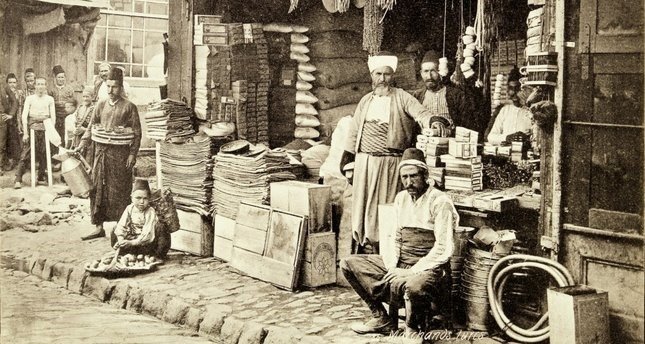
 Researcher Aisha Ghattas, in his doctoral thesis on modern history entitled “crafts and artisans in Algiers 1700-1830 socio – economic approach”, highlighted an important topic related to the craft organizations in Algiers in the Ottoman era, and the social strata that contributed to this.
The researcher says that her choice of the city of Algiers was due to several considerations due to the profound transformations that the city witnessed, starting from 1519 it became one of the important Mediterranean cities and plays the role of the advanced Western Front in the Muslim – Christian conflict.
The period from the beginning of the 18th century to the end remained one of the mysterious episodes in various aspects because it did not receive specialized study, and she wanted through the selection of the subject of the artisan segment, an important segment of society to paint a picture of the social and economic conditions of the community of Algiers from the beginning of the 18th century until the colonial shock of 1830.
The objective is to research in economic power and in the city of Algiers, any study of what was called at the time, the beauty of a term which was launched on trade professional sense corporation, and the trade of the Pyrenees also corporations ethniques namely, the development of which included elements of the entrant to Algiers of the interior, the study does not exclude any group contributed in production or in service.
Private zoom on Algiers community
The study seeks to shed light on the role of artisanal and commercial activity in the Society of Algiers on the one hand, and on the material conditions of the artisan segment on the other.
The study was divided into four sections, the first entitled The City community, which is devoted to the space in which the craftsmen segment of interest lives, and the emergence and development of the city.this section included three chapters dealing with the demographic structure in order to stand at the internal composition to give a picture of the social fabric, where it touched on the urban and the Turkish element and its components, the caragle and outsiders “expatriate elements”, the social organization applicable to the latter, and talk about dhimmis.
While the second section dealt with the craft structure in particular, where the number of crafts was one of the important issues that reflect the importance of the craft structure in the city, it dealt with the genetics of craft and craft choices in the same family, and moved to research the nature of the relationship between Authority and craft organizations and relations between groups to highlight the community as a framework for inclusion, Association, solidarity and solidarity.
The third chapter was devoted to the tax system to which the craft organizations were subjected, and the geography of craft activities, where the researcher touched on the nature of the topographic distribution of markets in terms of Specialization system, and stopped at the various establishments of an economic and commercial nature, such as markets, souks, hotels and welcomes, all indicators of the nature of economic activity in the city.
The fourth and final chapter was devoted to daily life in order to examine the characteristics of the lifestyle of artisans and the social practices and behaviors that characterized this segment, in addition to studying wealth and living standards, and to measure the material situation of the segment of artisans, Aisha Ghattas dealt with wealth and its distribution among other segments and in the artisan world in general, and at the community level in particular, and the strategy of smelters and the role of the craft in guiding them.
In this valuable study, the researcher relied on a balance of Ottoman documents, a series of records of the Sharia courts, the memoirs of Haj Ahmed al-Sharif al-Zahar, the captain of the supervision of Algeria, and a rare manuscript entitled :”This is a law on the markets of Algiers“, as well as the books of the House of money and the records of the bailik.
Organized institutions..
The study showed that the city enjoyed very important organizational and management institutions, and had a great impact on the control of daily life, including professional organizations, the local element, including Andalusia, contributed effectively to the management of the city, and the management was under the supervision of a wide range of urban employees with certain specific tasks.
In light of the statistical data related to the craft structure, the researcher concluded that the city included most of the different products and services it needs, and indicates that although it is difficult to distinguish between groups that were concerned with production and those that were concerned with marketing because some of them did the two works together, but it is possible to distinguish between three types of specialized craft groups in terms of their function, there are groups specialized in production, groups specialized in services and others in marketing, where she concluded that there are 99 crafts related to the owners of crafts shown by the records of the Sharia courts and the books of the House of money.
Preserving traditions and opening up to the other
On the other hand, the study confirmed that the principle of inheritance of the craft in one family was not fixed, but characterized by the choices of the craft in one family two prominent trends, the first of which is the craft or workmanship is almost inherited in all the artisan families that took over the secretariat of the workmanship, and indicates that reaching the highest ladder in the pyramid of the craft organization is due to the acquisition of skill, know-how and traditions of the craft, so those families were keen to work on its continuity over several generations in the same family, a prominent phenomenon in the considered and comfortable crafts such as perfume, heat, qazz, whistle and tanning.
The second is the diversification of professional choices, where there is a great difference between the activities practiced in the same family in terms of its geographical location and nature, one of the advantages of the artisan community is the preservation of the traditions inherited in a particular craft while opening it to other crafts, says Aisha Ghattas .
She adds that one of the features that seem prominent in the organization of crafts is the precision in the division of labor, as one community branched into several groups, and what was known in Algiers was similar to what was prevalent in the Maghreb al-Aqsa, especially in the Fassi style, where every craft or workmanship sheltered poly, but the craft groups did not have a religious tint, and found within each group a body of senior craft teachers.
The authority’s intervention in price control
Regarding the nature of the relationship between the authority and the craft organizations, the study points to the control of the permanent authority and its clear intervention in pricing and other issues, especially setting the minimum prices to avoid the occurrence of financial crises in the city, and until the middle of the 19th century, the prices of various goods and consumables, and the prices of services were determined and monitored by the highest authorities as important issues of the authority.
As for the economic trends of the city, the heat industry, i.e. silk, was the most prosperous and popular branch of production, and the statistical data highlighted that there is a clear superiority of commercial activity and crafts services in the city, indicating the contribution of most social segments in the literal life of the city and in various fields.
The study also showed that high-end crafts were almost exclusively urban, while modest service crafts were left to the expatriate elements.
One of the most famous families in the silk industry and the monopoly of this industry is the Buainin family, the family of Ibn Al-Mleih in Attara, the family of Al-Masstoul in the manufacture of Saddlery, the family of Hamadouch and the tanning industry, and others.
Translated by Hope from dhakira.echaab.dz
