



Tassili Cultural Park located in the Tassili n’Ajjer mountain range is considered one of the most important national parks in the world.
Formed by a sedimentary succession of sandstone in an arid region at an altitude of more than 1,000 meters, the Tassili Park in the south-east of Algeria evokes a lunar landscape due to the erosion of the rock formations rising above the sea. within the sand dunes. These are the combined action of stone-digging waters, wind polishing and the large temperature variations between night and day.
 Photo: Yann Arthus-Bertrand, L’Algérie vue du ciel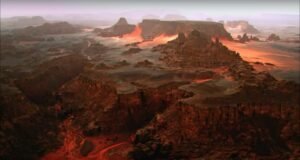
The park is home to many endangered animals such as the cuffed sheep and is the first park in Algeria by area (138,000 km2). It has been inscribed on the UNESCO World Heritage List since 1982 and classified as a biosphere reserve since 1986.
The Oued Djerat and the Sefar plateau
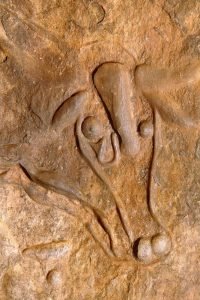
The rock engravings and paintings located in the Tassili massif date back around 10,000 years, to a time when the Sahara was home to a verdant landscape. The figures represented then evoke the daily life of the populations inhabiting the region, in particular with scenes of hunting and dancing. Some such Henri Lhotes saw in the prayer scenes a representation of the various encounters with alien creatures. These theses are however controversial and rather assimilated to an erroneous interpretation of ritual masks.
The rock paintings present in particular on the sites of Oued Djerat and the Sefar plateau vary in nature depending on the period. Thus, the period of the round heads sees the representation of mystical magico-religious practices, while the period of bovines presents with a realistic and naturalistic aesthetic the society of the time.
Photo: Trust for African Rock Art, The Crying Cow
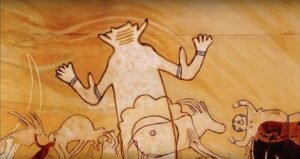
Photo: Yann Arthus-Bertrand, Algeria from the sky. Fresco of the “Great God” in Sefar spreading over an area of almost 16 meters in length.
 Photo: Yann Arthus-Bertrand, Algeria from the sky
There are currently more than 15,000 drawings and engravings in the Tassili rock park in a forest of rocks. The peculiarity of the region comes from the exceptional density of various prehistoric remains. In this way, rock art has been added to testimonies of prehistoric life, such as cave dwellings and tumuli covering burials.
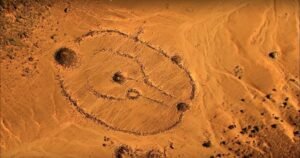
Photo: Yann Arthus-Bertrand, L’Algérie vue du ciel
Of unique universal value, the richness of the cultural heritage spanning a period of 10,000 years and the natural diversity of the site not only informs the evolution of prehistoric cultures and the pastoral way of life of ancient civilizations but also informs on the climatic and geological changes that the region has undergone.
Photo: Yann Arthus-Bertrand, L’Algérie vue du ciel
Source : translated from https://www.thecasbahpost.com/au-coeur-du-plus-grand-musee-neolithique-a-ciel-ouvert/
