



Where does the festival come from?
Eid al-Adha is also known as the Festival of Sacrifice. It celebrates a story about a prophet called Ibrahim (Abraham).
Allah (God) told Ibrahim he had to sacrifice his son Ishamel to prove his faith. Ibrahim decided to follow Allah’s command. The devil tried to convince him to disobey, but he refused. He threw pebbles at the devil to make him leave.
Ibrahim was about to sacrifice his son. He found that Allah had replaced Ishamel with a ram. Ibrahim had proved his devotion to Allah, so his son was spared.
Muslims celebrate to remember Ibrahim’s loyalty and obedience to Allah above all others.
When does it take place?
Eid al-Adha takes place on the tenth day of the last month of the Muslim calendar.
The Muslim calendar is a lunar calendar — it follows the moon. The months are based on the moon’s phases. That means it’s 11 days shorter than the Gregorian calendar. That’s the one you use at school that has 365 days.
So Eid al-Adha is celebrated on a different day every year.
How is it celebrated?
Let’s see how some have observed and celebrated Eid al-Adha in the past. Today, with social distancing many of these celebrations may not be possible. Some celebrations could be just with immediate family or might be online.
Some Muslims perform Hajj (a pilgrimage) in Saudi Arabia when Eid al-Adha begins. They throw pebbles at three large stone pillars in the city of Mina. This is where Muslims believe Ibrahim threw pebbles at the devil to drive him away.
This year, with social distancing in place, the event is scaled back. Only 60,000 people who are vaccinated and live in Saudi Arabia will be allowed to perform the Hajj .
Other Muslims celebrate by wearing going to the mosque in the morning for special prayers. Later, family and friends get together for a big meal. There’s lots of delicious food, including sweets.
This year’s gatherings will most likely be much smaller and families may meet online.
Are there any other special traditions?
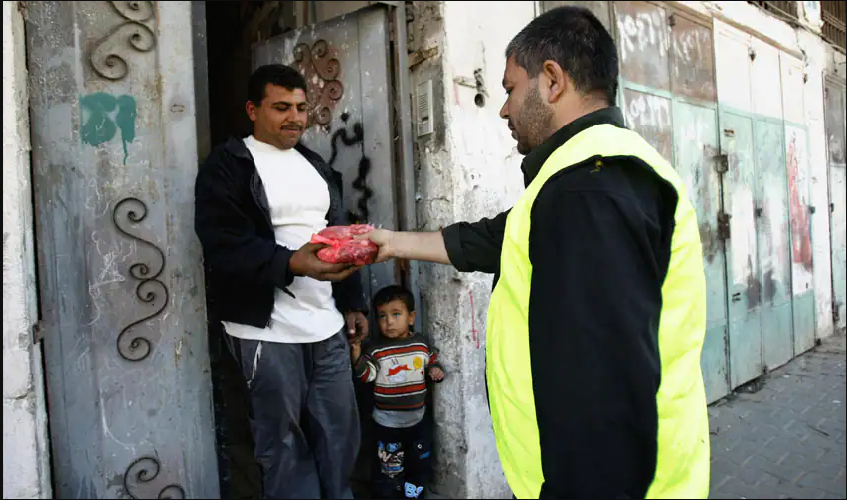
Yes! One important tradition for Eid al-Adha is helping those in need.
An animal, like a cow or goat, is sacrificed. The meat then gets donated to people who can’t afford it. Not all Muslims sacrifice an animal themselves. They can buy special meat from shops and donate that. Or they can donate money to charities that give special meat to others.
All these ways honour the story of Ibrahim. Taking care of others is a very important part of being a Muslim.
