



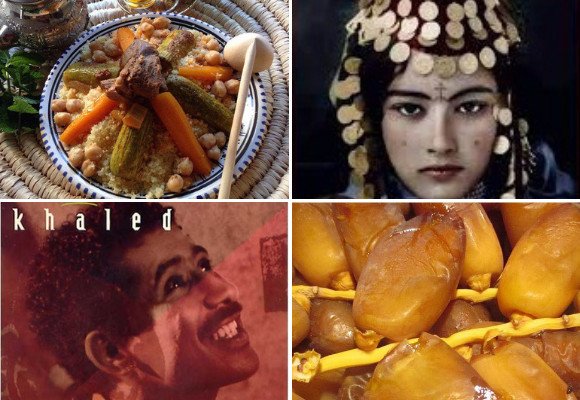
ALGIERS – Although not recent, attempts by third countries to appropriate Algeria’s cultural heritage have accelerated in recent times, often turning into heated polemics on social networks.
From couscous, a common heritage of ancient Numidia, to Raï music, born in western Algeria, via Chaâbi and Algerian “Karakou”, the list of intangible cultural assets, the authorship of which is disputed Algeria, continues to grow to integrate each time new elements of its vast heritage.
If riches such as the date (Deglet Nour) and local olive oil are often claimed by third parties who also appropriate the aura of Saint-Augustin within the framework of religious tourism, fanatics have moved on superior, by taking over everything that may represent a particular interest, and this, in defiance of historical truth.
“I even heard in a market in Rabat, a trader decline to foreign tourists the Southern Cross as being the work of Tuareg craftsmen from Morocco knowing that the latter do not exist in Morocco”, testifies to the APS Salwa, having stayed in this country.
But it is on the web that we take the full measure of this North African “battle” around heritage, the comments turning into “poisonous” attacks, in defiance of propriety and courtesy. “It was enough for me to say that argan exists in Algeria for my Facebook page to be blocked”, testifies a surfer, referring, moreover, to the recent “incident” which followed the declaration of the “Miss Morocco 2021” relating to his Algerian origins and which earned him a shower of virulent attacks from his fellow citizens. The concerned person having declared that her grandmother “transmitted to Moroccan women the art of embroidery”.
In addition to intangible heritage, Algeria is increasingly the target of attempts to appropriate its great historical figures, like the Berber sovereigns. A propensity which has become so exacerbated that enthusiasts of Algerian heritage have deemed it useful to react by creating, among other things, pages and groups on social networks dedicated to its preservation, by publishing articles and images therein corroborating the paternity of the Algeria on this one.
Massinissa, Syphax, Juba II….born in the land of Algeria
“We can be proud of having had leading personalities, born on Algerian soil, such as Massinissa, Syphax or Juba II. The latter who was a learned king whose museum in Cherchell demonstrates the artistic richness of his capital + Caesarea of Mauretania +. And what about the personality of Saint Augustine who was one of the lights of the Christian Church! “, underlines the historian Abderrahmane Khelifa, recalling historical names linked to the resistance, like Jugurtha and Takfarinas who “raised the whole of North Africa”, as well as Kahina, for the period having marked the advent of Islam in the Maghreb.
In the register of music, the director of the Algerian Agency for Cultural Radiation (AARC), Abdelkader Bendaamache, regrets that the practices of neighbors have not spared the “Chaâbi” style, maintaining that this style is “specific to Algeria and comes from the religious poetry founded by the great poet Sidi Lakhdar Ben Khellouf”.
And to continue: “it is thanks to the academician Boudali Safir that the Algerian repertoire was classified, for the first time in 1947, in 5 musical genres, including the “Madh”, but it was only after the independence of the country, that the musical orchestra of “Madh”, directed by El Anka, took the name of “Chaâbi”, before denouncing the “tendentious aims” having surrounded the production of the film “El Gosto” tracing the history of Châabi, because “far from the veracity of the facts”. So much so, he says, that its projection in Algeria was prevented.
Addressing the richness of the Algerian musical repertoire, this researcher in Bedouin literature ensures, moreover, that the “Hawzi” and the “Aaroubi” were created in Algeria before moving to the neighbors to the West, specifying that with the ” Gharnati”, associated with the Moroccan city of Fez, these musical genres are part of the “broad Andalusian heritage”.
For her part, the researcher at the National Center for Prehistoric, Anthropological and Historical Research (CNRPAH), Ouiza Gallèze, cites the wide variety of Algerian female singing represented in the troupes called the “Meddahate” in the West, the “Fqirat” in the East, “Lamsamaa” in Algiers, “Achouiq” in Kabylie and the “Srawi” in the Aurès.
Questioned, moreover, on the heritage of the Fantasia, she recalls that this one is registered on the list of Unesco by Algeria within the framework of the file “Pilgrimage of the Rakb of Ouled Sidi Cheikh” (2013), while as much as the Caftan, often object of “tightening” with the neighbors of the West, within the framework of the file “The nuptial costume of Tlemcen, Echedda” (2012).
Often attributed to Morocco, the Caftan was “brought back from Algeria around the 16th century during the Ottoman period, when Sultan Abu Abbas Ahmed El-Mansour discovered it there for the first time and was dazzled by it”, maintains Mr. Bendâamache.
For Mr. Khelifa, this dress is by no means exclusive to the latter: “It is enough to read the authors of the Middle Ages who evoke clothing in the Zirid, Hammadite, Almoravid, Almohad, Merinid, Zayyanid, Hafsid courts, etc. They were almost the same in Tlemcen, Fez or Tunis”. This, at a time when the heritage researcher, Abdelhamid Bourayou, considers it to be a “common Maghreb heritage”, noting its “Turkish” or “Andalusian” origin, while writings place it in Asia (Mongolia , Persia), where it was originally masculine.
Source : APS, translated by Hope.
