



by Roberto Consiglio
7 March 2022
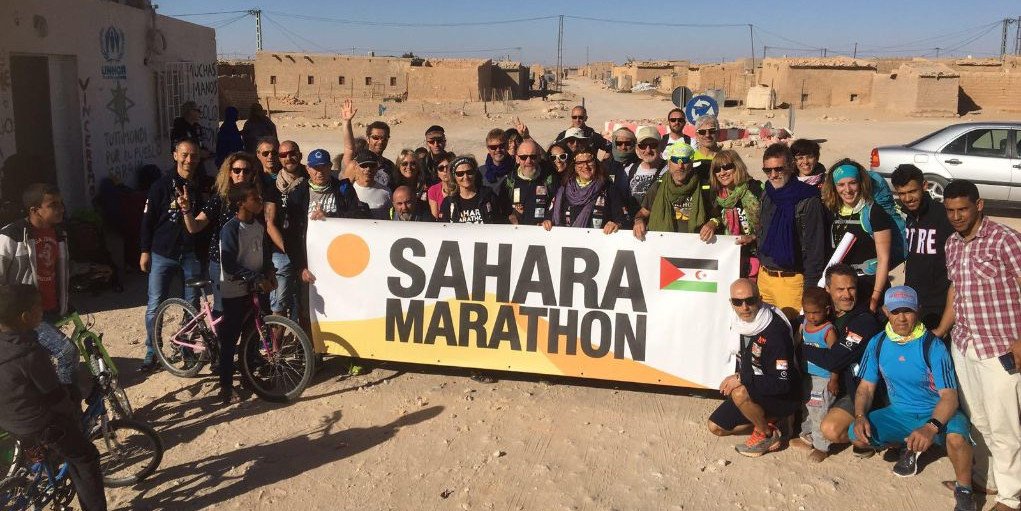
At the end of February, on the founding date of the RASD, a marathon was run through the Saharawi refugee camps. For the occasion we talked about sport and politics with Fatima Mahfud (Polisario Front in Italy) and Caterina Lusuardi (Saharawi Network).
At the end of February, the Sahara Marathon was held, a race organised by the Saharawi Arab Democratic Republic (SARD) that crossed the main Saharawi refugee camps. It is one of the initiatives in support of this people who have been living since 1975 under occupation or far from their territory, illegally occupied (according to international law) by Morocco, which exploits their wealth, including phosphates and fish resources. In November 2020, a new conflict broke out after almost thirty years of peace and the UN is unable to break the deadlock, despite the appointment of the new UN personal envoy for Western Sahara, Staffan de Mistura.
During these 47 years of Moroccan occupation, numerous organisations have sprung up to try to give voice to the Sahrawi question. Attempts are being made to give it a voice in various areas. One of the most active is in the field of sport, with the creation of the Sahara Marathon, a real race that crosses the area of western Algeria, near the city of Tindouf, where there are refugee camps housing 200,000 people. The marathon, on its website, describes itself as an ‘international sporting event of solidarity with the Saharawi people. Its first edition was in 2001, from an idea of Jeb Carney’. The organisation is entrusted to the RASD Secretariat of State with the help of numerous international volunteers.
There are three possible routes: 42, 21, 10, touching the three Saharawi refugee camps of Smara, Aoserd and ElyAyoun. There is also a 5 km route that is reserved for young people. There are two main objectives of the marathon. The first is to encourage the development of sporting activity among young Sahrawis, the second is to promote and develop humanitarian projects on the ground.
We caught up with Fatima Mahfud, the Polisario Front’s representative in Italy, and Caterina Lusuardi, the president of the ‘Saharawi Network’ (an organisation representing Italy at the European Coordination of Solidarity with the Saharawi people (EUCOCO), from whom we asked for more information about the marathon and the situation in Western Sahara. The two interviewees start with a premise, explaining that ‘in Italy, since the 1970s, there has been a solid and wide-ranging movement of solidarity with the Saharawi issue’. It was decided to focus on sport, organising an event like the Sahara Marathon, because sport has always united the peoples of the world.
By taking part in the marathon, you have the chance to walk through the provinces of the Saharawi refugee camps. A real field research that takes place in the days when we remember the foundation of the RASD in 1976. However, the key to understanding the Sahrawi issue has changed over time. In the 1970s and 1980s, priority was given to a political view of the issue. Subsequently, thanks to international cooperation projects and the arrival of the Internet, which enabled wider communication, real ‘knowledge trips’ began.
With the Sahara Marathon, ‘not necessarily politicised links’ were established, say Mahfud and Lusuardi. The event has led to projects covering a wide range of areas, from support for education to sport, training for sports staff and the creation of local work cooperatives.
Sports training covers different disciplines from football to boxing to athletics. Fundamental is the training of female personnel and the teaching of the relationship that the body has with health.
When we ask what are the main difficulties that the Saharawi people are facing today, the representatives of the Saharawi Network and the Polisario Front say that there are two fronts. The first is “that of managing daily life in the refugee camp. The Saharawis have managed to bend life in the desert in their favour by becoming largely sedentary, forcing many to give up nomadism’. Despite many difficulties, the Sahrawis have never lost their dignity, trying to ensure health, culture and education for all. The second aspect, on the other hand, is of a purely political nature, as Mahfud and Lusuardi wonder how much longer the Sahrawis will have to wait before their right to self-determination can be implemented.
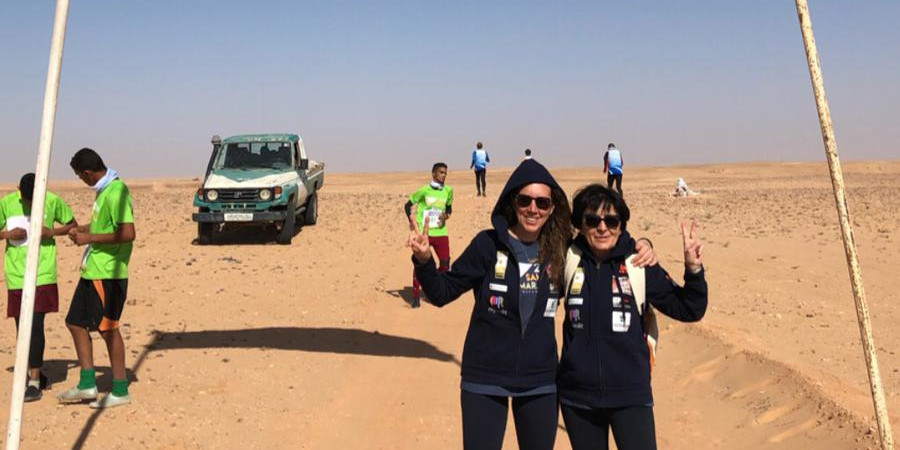
During the sports explanations on the Sahara Maraton website, the adjective ‘popular’ is used several times. Why such a linguistic choice? “Popular because everyone can participate. There are also short routes, such as the 5 km route, which you can do by simply walking and greeting the Sahrawis you meet along the way. It’s a festival that you can experience by walking and that allows you to get to know the desert and follow the same paths as the first Saharawis who arrived there and had no means of transport. Those who do the long routes will savour the silence of that space, seemingly without barriers, and looking towards a wide and distant horizon as if it were the edge of the world”.
Unfortunately, sport is also used as a showcase for world sporting events that ignore the situation of the Sahrawi people. In Dahkla, a coastal town on the Atlantic Ocean in Moroccan-occupied territory, an important stage of the world kitesurfing championship has been held for several years.
Foum Labouir beach, with its winds, is considered a perfect place to practice this discipline. The event is organised by the Global Kitesports Association, one of the most important kitesurfing bodies in the world, under the aegis of the World Sailing Federation, the world federation for sailing sports, which has never spoken out on the Moroccan occupation.
The Polisario Front’s representative in Italy is very tough on the subject and claims that something illegal is going on in Dakhla. This position derives from the fact that Western Sahara is ‘under international law a non-autonomous territory and Morocco is an occupying power that has no right to authorise anything on that territory. The problem is that for years various observers have been prevented from entering Western Sahara and the land continues to be stripped of natural resources that would bring economic benefits to the Sahrawis. There are rulings in favour of the Sahrawis that are being enforced through complaints and trials. Therefore those territories cannot be included in the trade and fishing agreements between the European Union and Morocco. Sooner or later this ruling will be applied”.
Moreover, the Polisario Front representative continues: “Currently, Western Sahara is turning into an open-air prison because Sahrawis are being prevented from leaving their homes, as in the case of Sultana Kaya who is imprisoned in her own home”.
When the two interviewees were asked if there would ever be a way out of this stalemate, the answer was decisive: “The Secretary General is called by his role to maintain stability, justice and the strict application of international law. The former UN Secretary General Kofi Annan, by declaring that the Western Sahara issue is a dead end, has admitted an inconsistency because it is his primary responsibility to prevent the Saharawi issue from entering a dead end”.
This strong stance is based on the fact that there are ‘huge sums of money that the United Nations itself has spent on the mission in Western Sahara. It is no coincidence that there is an actual mission on the issue, called the United Nations Mission for the Referendum in Western Sahara’. Initiatives such as the Sahara Marathon can, however, contribute to raising awareness of the reality of the Sahrawis and the struggle they have been patiently conducting for almost fifty years.
All images courtesy of Saharawi Network
Translated by Hope from https://www.dinamopress.it/news/sahara-marathon-fra-sport-e-diritti-dei-popoli/
