



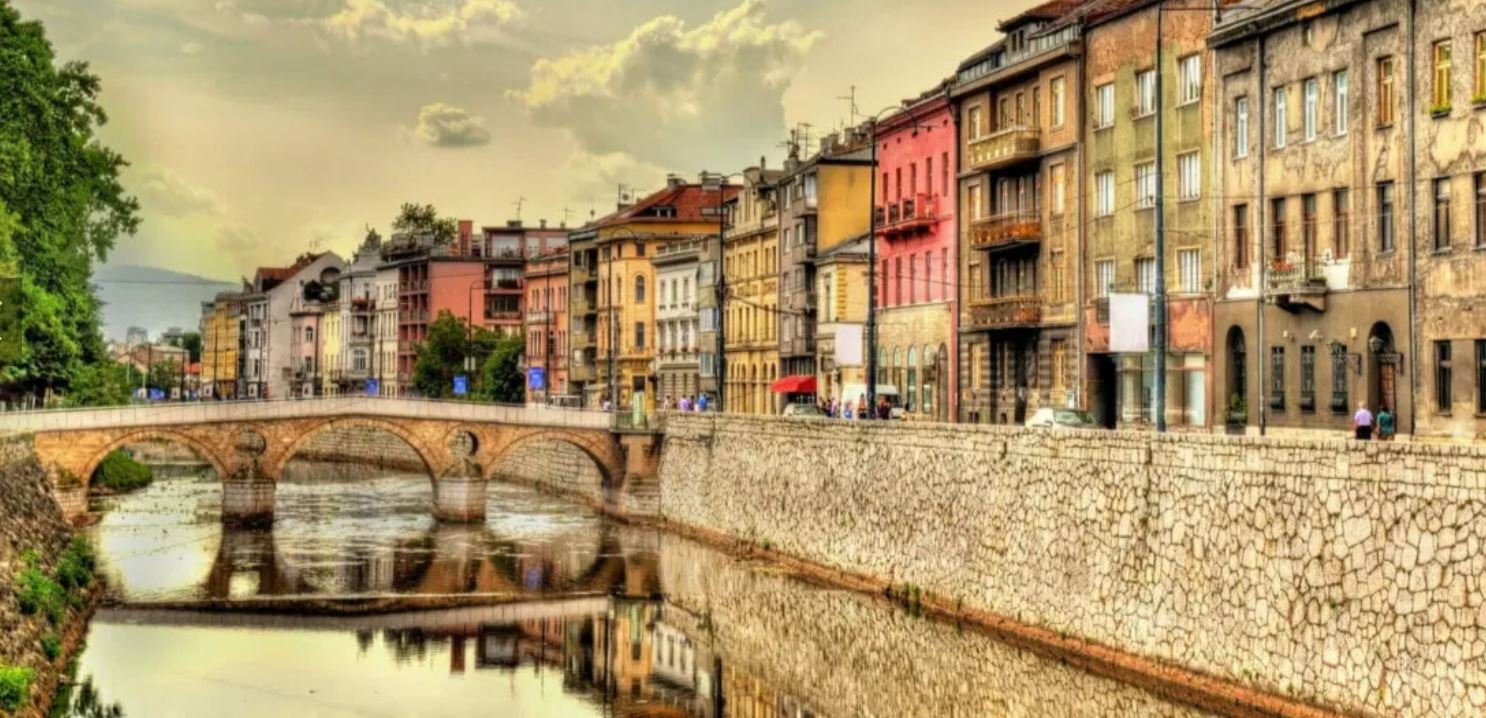
If you think that war, wall and desert have nothing in common, you are wrong. Or rather, you haven’t connected the emotions with three very different countries, three completely different identities, but with a common denominator: the scars left by a tortuous and painful history that they do nothing to hide, but proudly show to the visitor, to hunting for memories to bring back home with more passion than a simple souvenir. Here, Sarajevo, Palestine and Algeria are three pieces of a mosaic mixed with living beauty, the kind that stick to your heart before your eyes. From the Balkans to the Middle East to Africa, let’s then let real life guide us through the streets of three destinations that have nothing trivial. But absolutely nothing.
You say Sarajevo and you think of destiny. The Jerusalem of Europe, but above all the spark of the First World War and symbol of the war in Bosnia and Herzegovina, for having suffered the longest siege in war history at the end of the 20th century, from 5 April 1992 to 29 February 1996: 12,000 dead.
Yet Sarajevo is much more, from the Latin Bridge to the Tunnel Spasa to memories of the 1984 Winter Olympics, but it is undeniable that many come to visit it to see the wounds of the war in the Balkans, admits Faruk Caluk, senior advisor of Tourism Development of Sarajevo : «Yes, and it will be like this for a long time to come. There are many places that we have preserved to keep alive the memory of a conflict that ended 28 years ago. Obviously the wounds inside us have remained well impressed and we don’t want to forget, we can’t forget, it’s impossible. The new generations know what happened, but no one knows what it means to have survived then in Sarajevo»
Here, in short, history knocked heavily on the door twice. «But Sarajevo has culture, traditions, it is a mix of races and religions – notes Caluk – our wealth is precisely this: every nation that has passed through here has left a mark. The cuisine, for example, draws on different ethnicities. Here people live more lightly and it is very welcoming. So much so that it is one of the favorite destinations of Italians, always in the top ten of tourism in Bosnia and Herzegovina. Covid and the Russian-Ukrainian war have slowed down incoming, because in 2019 our tourism was at the top, but for a few months we have been exceeding the pre-pandemic numbers».
History, wounds, memories: a common thread links Sarajevo to Palestine, which cultivates a dream beyond the wall, the Israeli West Bank barrier, which runs for 730 km along the border with the West Bank, the region which, together with the Gaza Strip constitutes the Territories. Palestinians call it the apartheid wall: “It’s a truth that everyone wants to see,” underlines Magdouline Salameh, head of relations with the Italian tourist market at the Ministry of Tourism and Antiquities.
It is she who accompanies us in the discovery of a world seen from the outside with too many prejudices and little real knowledge: «There is only one way to change your mind about Palestine: to come here and see the truth, not only for the aspects related to faith, but to admire the natural beauties. Many come here for the first time with an idea and images that are different from the ones they bring back when they return to their country». A world that Italians appreciate as it is, without filters. «Italy has always been an important market for Palestine: in terms of numbers, it ranks at the top together with Russia, the USA, France, Germany and Romania. Naturally many Italians come on pilgrimage to Bethlehem and the Nativity, but now they are starting to look for something else».
And here we return to the Wall: «Many tourists ask to integrate themselves into Palestinian society. Even the wall built by Israel has become a place of attraction, it is the sign of a passion for our history. Many ask me: “Do we want to come to see the wall”, because it exudes a strong sense of spirituality and emotions. And many come to paint on the stones, such as the British artist and writer Banksy, who has opened a hotel called the “Wall Off Hotel”, with a view right on the wall in Bethlehem, which has almost become a museum». Palestine does not have a reference airport, so tourists wishing to visit Palestine have two options: land in Amman, Jordan, and reach their destination by bus, or Tel Aviv, Israel, and enter Palestine from East Jerusalem or Ramallah .
Algeria also has a wall, of sand though: the desert. It is part of the Sahara and occupies more than four fifths of the entire territory. An incomparable charm, explains Mouissi Mohammed, tour operator Algeria “Adventure Mouissi”: «Algeria, which is eight times the size of Italy, hosts that part of the desert, the Tadrart rouge, considered the most spectacular and fascinating in the world. It is the first thing a foreign tourist asks to visit, because it is what is “different”. It is a strong emotion, “the end of the world”, as they say in the Tuareg language, because that is the feeling you get when you get there».
The growth of Italian tourism in Algeria has been exponential. «Absolutely yes: they are the first in terms of flow. I am working mainly with Italians and the hotels are full of your compatriots: it is good both for you and for us, because this creates a great movement from an economic point of view. Moreover, since there are agreements between Algeria and Italy on energy, the collaboration between the two countries has increased».
Algeria also means the Roman Empire, with the archaeological remains of Timgad, the ancient Thamugadi, considered the Pompeii of Africa, an almost intact city that seems to have been recently built. Yet those who speak of Algeria seem to refer only to the past, ignoring a completely different present: «Yes, it’s true. Everyone immediately thinks of the 90s, of the Drama, the civil war in Algeria which lasted from 1991 to 2002, or even of French Algeria, before the war of liberation, fought between 1954 and 1962. Ours, it is good that they know everyone, it is a free country, rich thanks to oil and gas, with great opportunities and we are working to give this new image”.
Translated from https://www.lagenziadiviaggimag.it/sarajevo-palestina-e-algeria-viaggio-nella-memoria/
