



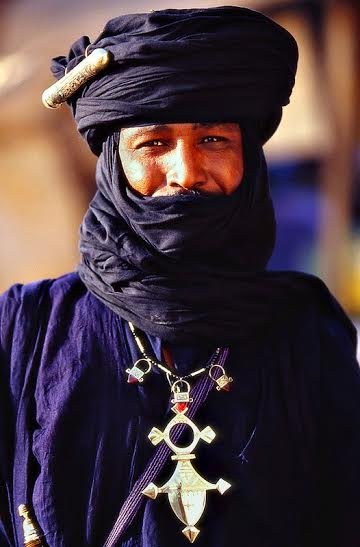
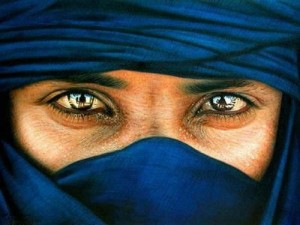
The veil among Tuareg men is not just a matter of aesthetics. The taglmoust, the centerpiece of the male appearance, reflects a vision of the world anchored in an unaltered cosmogony, and testifies to an art of living that never ceases to fascinate
Symbolic
Taglmoust is a veil that can reach eight meters in length. It covers men’s faces, leaving only the eyes to be seen. Its length differs according to the rank and caste of the wearer. Nobles wear it very long, unlike men of lower rank, who do not suggest much sophistication.
“The veil. It is above all a piece of clothing for the salon, society, ceremony, something similar to our gloves, but much more strictly essential” Remarked M.E.F. Gautier.
Also, its port takes on a reading that still arouses today, a very mysterious imagery. The fact that women appear less covered, draped in fabrics that do not obscure their faces like men do, helps fuel the fantasy. Moreover, the western traveler of the early 19th century embroidered a phantasmagoria on the wearing of taglmoust, and various theories abounded on this “moderate” society. One of these hypotheses highlights a local legend that there was a time when women were most valiant during war; since that day, the men, ashamed and confused, would have worn a veil which almost completely covered their faces. It is true that women enjoy a privileged status in Targui society; but their way of life refutes this theory. Masters of homes and tents, they are not forced to nomadize or move away from the camp. Thus, they are not confronted with external conflicts, nor with the void, this space of superstitions and evils.
Worn from the boy’s puberty, the Taglmoust underlines, like a rite of passage to adulthood, the latter’s emancipation from the maternal tent, towards the world of men. He will now have to measure his words, take part in society, and tame the outer “essuf” space. Finally, the codified character is easily highlighted through the lexicon around the taglmoust. Indeed, the fabric is composed of two sections, called amawak wan eres (bottom guardian) and amawal wan afalla (top guardian). The guardian, preserve the man from his stupidity and his awkwardness; thus, this glossary, directs us towards a philosophy which advocates the measure in the gestures and the words. “The veil which they fold down over their forehead and over their mouth constantly recalls the solitude from which they protect themselves, and where the most talented draw the material from poems which paint them as in principle society makes them be: away from tents. Explains anthropologist Casajus.
Translated from : https://babzman.com/taglmoust-le-voile-chez-les-hommes-du-kel-tamasheq/
