



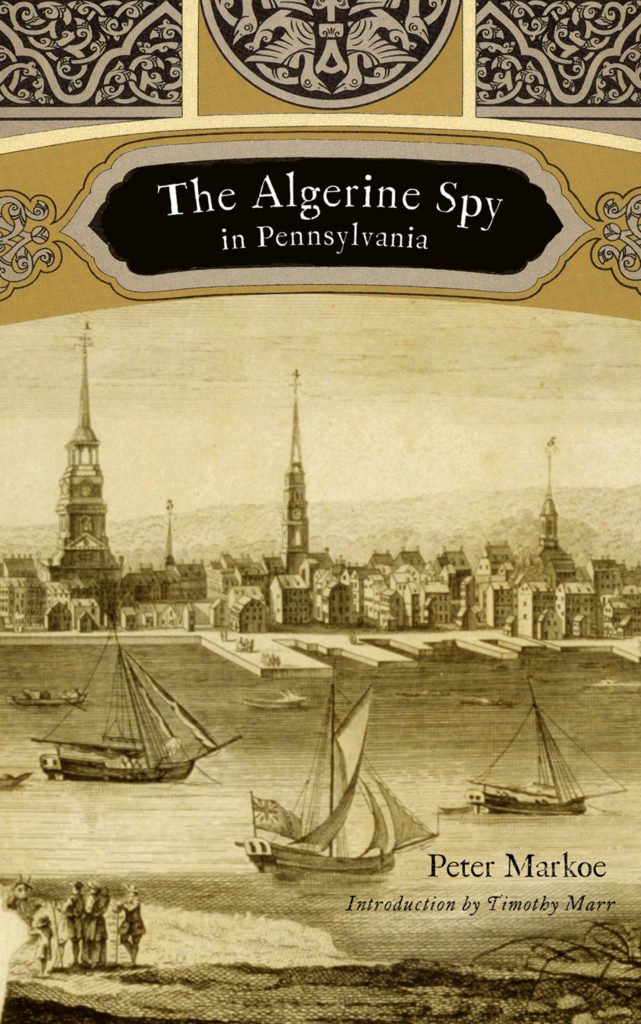
An Important Book in the History of America’s Encounter with the Arab World
In 1787, while American sailors languished in a Barbary prison, delegates debated the Constitution in Philadelphia. Despite America’s desire to respond to the crisis, without a central government, the new republic had no means to create a naval force. Enter an anonymously published book, The Algerine Spy in Pennsylvania: or, Letters Written by a Native of Algiers on the Affairs of the United States in America, which began circulating among the delegates. Consisting of a series of letters ostensibly written by an Algerian agent “Mehmet” back to his leader, the spy predicted that the former colonies would never be able to resolve their differences and be ruined by disunion. The book created a sensation and it helped tip the balance for those in favor of adopting the new Constitution. Following the Constitution’s ratification in 1789, the United States created a navy and began asserting its power overseas. With its commentary about men and women, business and pleasure, and historical and religious comparisons between nations, The Algerine Spy in Pennsylvania provides both a contemporary snapshot of early American life and the political ideas of the period.
Never before reprinted and rated one of the five best works in the history of America’s encounter with the Arab world, this new edition is edited by historian Timothy Marr, who reconsiders the importance of this early work in the political and literary history of the United States.
Peter Markoe (1752?–1792), a poet and playwright, immigrated to Philadelphia from the West Indies in 1783.
Timothy Marr is associate professor of American studies at the University of North Carolina and author of The Cultural Roots of American Islamicism.
Praise for The Algerine Spy in Pennsylvania:
“A pungent satire on American affairs”—Samuel Eliot Morison
Five Best Books of 2007 by the Wall Street Journal.
These works vividly capture the long history of America’s encounters with the Arab world, says Middle East expert Michael B. Oren.
1. An Algerine Spy In Pennsylvania
By Peter Markoe, 1787
“An Algerine Spy in Pennsylvania” appeared in Philadelphia at the time of the Constitutional Convention and as America faced its first hostage crisis in the Middle East. Pirates from the so-called Barbary States — Morocco, Tripoli, Tunis and Algiers — had waylaid American merchant ships in the Mediterranean and enslaved 127 sailors. The attacks posed a mortal threat to America’s fragile economy, yet the country was powerless to repel them. Loosely confederated, the U.S. had no central government and no mechanism for creating a navy. Enter Peter the Poet, as Peter Markoe was known, the Bard of Philadelphia. Supposedly a collection of letters written by “Mehmet,” an Algerian agent operating in the U.S., Markoe’s book predicted that the pigheaded Americans would never federate. “Totally ruined by disunion,” he gloated, “they may be plundered without risque and their young men and maidens triumphantly carried into captivity.” Markoe’s satirical provocation helped tip the bitterly contested debate over the Constitution in 1789. Five years later, Congress authorized the construction of a navy “for the protection . . . of the United States against Algerian corsairs.” The country subsequently dispatched Marines “to the shores of Tripoli” and a fleet under Stephen Decatur to vanquish the pirates. Americans had formed a truly United States, had created naval power and had projected it thousands of miles — thanks, in part, to Peter Markoe.

1 comment
After I discovered this book by chance, I translated it into Arabic, and it required a great effort from me, and soon it will come out to the Algerian reader after more than two centuries of its publication.