



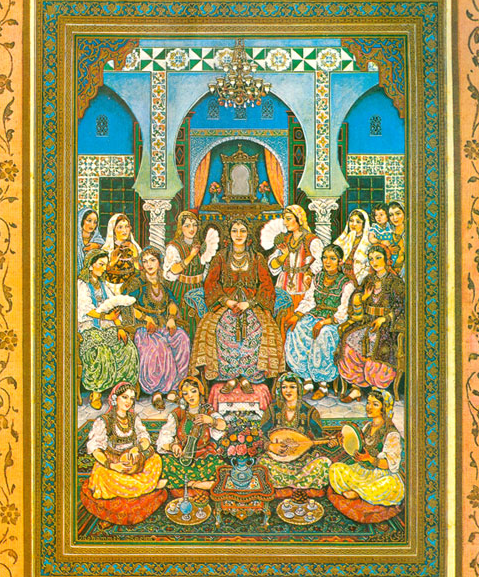
The fiancée’s party – El arss fi dar laaroussa
Following the bride’s bath, after dinner, the bride’s family devotes the evening to henna night, “lailet el henna”. This ceremony is also called Large henna, the small henna having already taken place during the dfou. Music and dance punctuate the evening, sweets and drinks are distributed. The trousseau is brought to show some pieces to the assistants as well as “gifts of honor” made to the father and brothers of the groom if he has any.
In the middle of the evening, the bride is brought in for the henna break. Dressed in a short velvet caftan with an open point, a silk sarwal and adorned with jewels, the bride wears very little make-up. Her ankles are decorated with khelkhal and her feet are shod in blighat (yellow leather mules embroidered with gold with silk tassels). On the head is a sarma. The matchmaker made her sit on cushions and covered her with a pink silk-woven haik.
The ceremony begins, the “hounnana”, the henna applicator, assisted by one or two women, prepares the mixture while singing (teqdam). The tattooist dress creates fantastic geometric designs and floral patterns on the bride’s hands and feet. At the end, you wrap your hands and feet in a silk scarf. Once the operation is completed the “hunnana” sings a few verses and covers her with blessing:
“Ya banti, ya lalla, ya redjlin el hmama Qouli l-lahbabak bi slama” (O my daughter, O my lady, O you who have dove feet. Say goodbye to your family)
Chants and youyous ring out as a little boy is placed on the bride’s lap to wish him a firstborn. The festive atmosphere continues until dawn: music with different instruments, dancing with candles, distribution of cakes and drinks to the guests.
The khouara: it is the feast of the bride given by the parents of the bride.
The khouara begins Thursday morning (wedding day) and continues with a reception in the early afternoon. It precedes the wedding night. This reception is exclusively feminine during which the young bride is presented to the guests (her relatives and those on her husband’s side, friends and neighbors).
Thursday morning: first, in the strict privacy of the family, with a few very close guests, a closed ceremony. The preparation of the bride by the maachta (hairstyle / make-up / perfume the body). The bride then retires to a room with several girls who keep her company.
Thursday afternoon: the guests begin to arrive, they are received by the mother in wasst edar, they are made to sit on the mattresses and carpets while the female orchestra composed of the medaha (singer), her musicians and dancers s ‘install. They perform traditional dances and sing in chorus. Drinks and cakes are served.
Throughout the day we go regularly to look for the bride dressed in her most beautiful toilet. She is made to sit down for a few moments, like a queen, facing the guests to better show her toilet. This exposure pose is called “Tasdira”. Once the parade is over, the matchmaker, who looked after the bride throughout the evening, escorts her back to her room. She will stay there with her friends and cousins until they come to pick her up and take her to her husband’s house. Meanwhile the music and dances continue in west edar.
The departure of the bride for the marital home – Rfoud laaroussa
The groom’s family arrives with a procession and a troop of zorna to look for the bride. They are well received. When the moment of departure announces, the mother of the bride is courteously asked to give them “aaroussethoum” (their bride). The matchmaker then goes to look for her and leads her to the door of the house. On the threshold her father is waiting for her, he extends his right hand above his daughter’s head, as she walks past sobbing silently. The mother hugs her daughter to her breast. The father then gives it to the groom’s father or his representative.
Due to the narrowness of the alleys in the Kasbah, a beautifully harnessed mount is often used to transport the bride. Once the bride is installed on her mount, the procession begins to move slowly towards her husband’s house. Zorna and youyous continue.
The fiancé’s party
The party continues at the husband’s house with a troupe of musicians and dancers led by el medaha (singer). The troops are installed in the section reserved for women.
Arrival of the bride at her marital home
The procession stops in front of the door of the groom’s house. We bring the bride down. The husband’s father places the bride under the hem of her burnous until she is in the hall and the groom’s mother comes to meet her. She hands her a key and a lump of sugar in her mouth, then leads her into the bridal chamber. The matchmaker accompanies him. Couscous sprinkled with sugar are served to the bride. A dinner is prepared for the guests who keep arriving. The musicians are making themselves heard.
The husband dines with a few friends. After the meal he disappears with his companions. All the guests stay to attend the concert, this time given by the meddah and its musicians who come to take their places with the men a little later, after the female orchestra has retired. Drinks and pastries are served until late in the evening.
The bride’s toilet
The maachta is called to go to the bridal chamber. She does the bride’s hair and dresses and she reviews her makeup. Once ready, the mother-in-law leads her to the central courtyard, on the women’s side, to present her to her guests. As the bride sits on four golden cushions (so that she dominates the room), the meddaha sings her beauty – praise – “ta’lila”.
The maachta is spreading a large square of white damask fabric on her knees. Then aloud she makes this announcement: “bismillah wa salat ala rassoul ellah (three times) man djab chay waada iqerebha lana. Yarham walidih “(Whoever has brought his offering comes near to us and God have mercy on his parents.)
The parents and friends of the bride present the taoussa (gifts): jewelry, rich clothes, coins,… to the bride. The collection is entrusted to the mother of the bride, who keeps all the change and puts the belongings in her daughter’s cupboard.
Then we spread another scarf belonging to the mother-in-law who receives the taoussa, from her guests, which is made only of coins.
The bride’s entry into the bridal chamber
The young men grow impatient, the friends of the groom knock on the door so that the bridegroom can join the bridal chamber. The women then install the bride in the room facing the door. His face is covered with a handkerchief with a white head called a tchekkat lebra (muslin).
Women throng into the room, but as soon as the husband approaches they go out, all that remains with the bride is the maachta or the matchmaker (the maachta is said to sit with her because there is fear for the bride. “The kidnapper of the wives”). The bridal chamber is usually on the first floor.
The maachta or the matchmaker is responsible for introducing the groom to the bride: in the presence of the two families, the matchmaker pours orange blossom water into the hollow of the joined hands of the bride who makes her drink it. husband. It is then the husband’s turn to repeat the same operation.
After the audience leaves the matchmaker says to the husband, “khoud ma aatak ellah” (take what God gave you), the husband gives her a large coin before she slips away.
Translated from : https://babzman.com/le-mariage-traditionnel-dans-el-qacba-zeman-partie-iii-le-jour-des-noces/
