



Source: journalofethnicfoods.biomedcentral.com
The cheese Klila occupies a very important socio-economic place established in the rural and peri-urban environment. It is a fermented cheese produced empirically in several regions of Algeria. It is the most popular traditional cheese and its artisanal manufacturing process is still in use today. The processing consists of moderate heating of “Lben” (described a little farther) until it becomes curdled, and then drained in muslin. The cheese obtained is consumed as it stands, fresh, or after drying. When dried, it is used as an ingredient after its rehydration in traditional culinary preparations.
In this review, we expose the main categories of traditional Algerian dairy products; we focus mainly on the traditional Klila cheese, its history, origin, and different manufacturing stages. We recall the different consumption modes and incorporation of Klila cheese in the culinary preparations.
Introduction
In Algeria, the consumption of dairy products is an old tradition linked to livestock farming, since dairy products are made by means of ancient artisanal processes, using milk or mixtures of milk from different species . There is a wide variety of artisanal dairy products (from the “terroir” in French), their denomination as well as their manufacturing process differing from one region to another. These products also differ in their taste and their consistency.
“Klila” is a fermented cheese produced empirically in several regions of Algeria. It is the most popular traditional cheese and its artisanal manufacturing process is still in use today . The processing consists of moderate heating of “Lben” (described a little farther) until it becomes curdled, and then drained in muslin. The cheese obtained is consumed as it stands, fresh, or after drying. When dried, it is used as an ingredient after its rehydration in traditional culinary preparations .
Traditional dairy products in Algeria
History and origin of cheeses
According to Fox and McSweeney [9], the word “cheese” comes from the Latin “formaticus” meaning “what is done in a form.” The discovery of cheese was probably by chance, of unknown precise origin, but archaeological discoveries indicated that cheese is made from the beginning of breeding. The first traces of dairy farming date back to 10,000 years in the Middle East. Sheep and goat milks were apparently the first processed milks, and sheep and goats have been the first domesticated animals .
The discovery of utensils and containers used in cheese making during the numerous archaeological excavations that took place around the world, and in particular in Egypt, Mesopotamia, or in the Mediterranean basin, has given evidence of the very ancient use of these fermentations. Cheese was already a popular food item during the Greek and Egyptian eras [11]. It is thanks to the Romans that the art of making different types of cheese was developed . Cheese making is the oldest known way of preserving milk . Man has noticed that the milk he was storing coagulated and that once it is separated from its serum (whey), the coagulum becomes a compact mass that could dry and thus be preserved and transported. The spontaneous acidification is causing the coagulation and giving rise, because of its slowness, to the cream on the surface; fermented milks, butter, and dry cheese were probably the first dairy products.
Algerian traditional dairy products
Contrary to popular belief, Algeria does have well-established traditions of manufacturing dairy products even if the activity is limited to the domestic sphere. The traditional dairy products, with strong cultural, medicinal, and economic value, are the historical product of the social and economic dynamism of the rural communities of women [16]. Despite their anchoring in the Algerian culinary tradition and their ability to exploit the natural resources of disadvantaged regions (animal and plant species of mountain and Saharan ecosystems), these products evolve on the margins of implemented development policies in Algeria. The great majority of them are being downgraded by the markets through the emergence of dairy processing industries oriented more towards the satisfaction of the major urban markets, in subsidized milk and dairy products, than towards the valuation of local milk production .
Many traditional products are vanishing for various reasons, including lack of feed availability, rural exodus, and changing dietary habits. Those ones, whose use is most widespread, such as Rayeb and Jben, and while keeping the same name, have changed their technological process because of their industrialization].
Main categories of Algerian traditional dairy products
The different types of Algerian traditional dairy products are shown in Fig. 1.

Fat dairy derivatives
Zebda (butter)
“Zebda” or fresh butter is obtained after churning “Rayeb.” The latter is added by a quantity of warm water (40–50 °C) at the end of shaking to promote the agglomeration of fat globules and increase the yield of butter. Lipid globules appear on the surface and are recovered at the end of churn . The fresh butter obtained has a soft consistency due to the high concentration of water. It is also made in Middle Eastern countries and is known as Zobdeh .
Smen
The surplus of butter produced is transformed into rancid butter “Smen” by washing the fresh butter with warm water, brining, then dry salting (dusting on the surface, 8–10 g/100 g) . Smen is a fatty milk derivative popular in the Maghreb countries, notably Algeria and Morocco.
Shmen (Semma)
“Shmen” or “Semma” is clarified butter oil obtained by churning spontaneously acidified camel milk . The butter is then boiled and clarified after the addition of a clarifying agent (for example, crushed dates) and skimming after flocculation of the impurities. It is used by the Tuaregs (Algerian Sahara people) for the preparation of food or for cosmetic purposes .
Traditional fermented beverages
Raib
“Raib” is a fermented milk produced in many Mediterranean and sub-Saharan countries . “Raib” is curdled milk, traditionally obtained after spontaneous acidification at room temperature of raw milk during a period ranging from 24 to 72 h; it is consumed as it is or transformed. Fermentation has been associated with mesophilic lactic acid bacteria belonging to the genera Leuconostoc and Lactococcus naturally present in raw milks .
Lben
“Lben” is one of the best-known products of artisanal milk processing; it is prepared following the churning of “Raib” and butter separation . Churning makes it possible to collect the majority of its fat in the form of butter called “Zebda.” The homemade or family preparation of “Lben” is simple: the milk is left to itself in a “Rawaba” terracotta pot until it coagulates . This is done at room temperature and lasts 24 to 72 h .
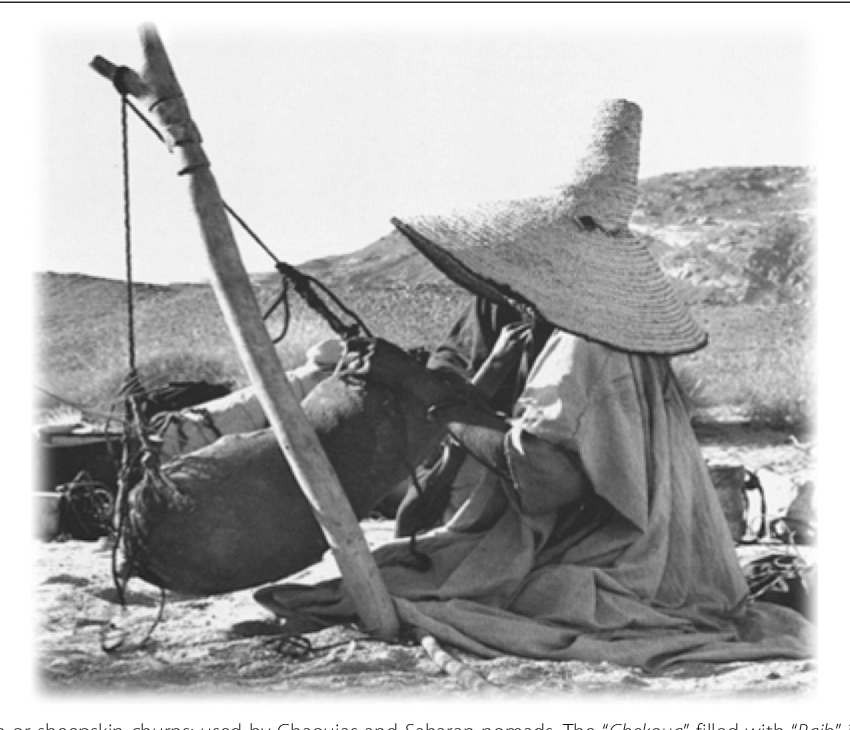
The gel formed is stirred by a spoon or a ladle to facilitate his transferring in the container used for churning or “Makhda.” Since ancient times, three types of traditional churns, varying from one region to another, are used in Algeria. Chaouias and Saharan nomads used the “Chekoua” (Fig. 2). It comes from a laborious treatment of goat skin or sheep skin. The “Chekoua” filled with “Raib” is suspended to a tripod or a beam and vigorously agitated from front to back until the coalescence of aggregates of fat particles. The fat particles then agglomerate together, to form grains of butter . In the region of Eastern Kabylie (K’bayel el Hedra) Ferdjioua, Mila, and Jijel, women used terracotta utensils called “Mezla” or “Artoul” when it came to small volumes
On Djurdjura, Kabyle (other regions in the North of Algeria) women use “Thakhssayeth Oussendou” also called “Thakhchachet”. This choice was not made at random; on the mountainous and rigid soil of Kabylie grow trees and plants including the calabash. This slightly exotic fruit, rigid and empty from the inside, serves as a traditional churn in Kabylie. The manipulator must shake vigorously, and then add small amounts of hot or cold water depending on the ambient temperature, so as to bring the temperature of the set to a level suitable for collecting the grains of butter. The churning operation lasts 40 min until 1 h and 15 min. “Zebda” is collected, usually by hand
Currently, “Lben” is currently manufactured industrially , and this dairy product remains largely manufactured nowadays by craftsmen according to its traditional process in the Maghreb countries, notably in Algeria, in Tunisia craftsmen, as well as in Morocco . “Lben” is the basic ingredient for making the traditional Klila cheese.
Algerian traditional cheeses
Cheese is the largest and most diverse group of dairy products. Their artisanal production is strongly linked to the “terroir” . Traditional cheeses are cultural goods that deserve to be studied, characterized, and protected . Some cheeses are known, made, and eaten to the present day, while others are unfortunately endangered for various reasons, namely the unavailability of fodder, the rural exodus, and the change in food habits. Traditional Algerian cheeses are distributed into four main categories, namely fresh cheeses, ripened cheeses, processed cheeses, and hard cheeses.
Fresh cheeses
Jben (Aguissi)
Jben is traditionally made in the Maghreb countries; denomination gathers very different technological trajectories, resulting in products with very varied characteristics . A stage of spontaneous acidification can usually occur at ambient atmosphere, during 24 h to 72 h depending on the temperature. “Jben” cheese is made with raw sheep milk or goat milk, spontaneously acidified and coagulated by coagulating enzymes of plant origin from cardoon flowers (Cynara cardunculus L.), a wild thorny plant (Cynara humilis), artichoke (Cynara scolymus), or pumpkin seeds [35]. The whole flowers are macerated in the milk. The plant is used to accelerate the coagulation and to give a taste to the cheese. The plant variety used varies from one region to another; it gives a taste and a texture appreciated by the people of the concerned region. The curd is then drained and salted or not, according to the tastes.
As described Benkerroum and Tamime , the “Jben” in Morocco can be hand made without enzymatic coagulation; in this case, raw milk is only coagulated by spontaneous acidification, and then the curd is drained for 2 to 3 days to obtain the desired consistency. Additives can be added after draining and salting (garlic, parsley, pepper, etc.). The cheese obtained in other Arab countries corresponds to cheese named “Jibneh Beida”.
Finally, a third technological process, using animal rennet, cow milk, and acidifying starters, is industrially used. Depending on the region, the “Jben” may be salted and then drained for 10 days, or unsalted and drained for less than 4 days, with an average of 62.5% moisture, 16.5% fat, 15.8% crude protein, 4.1% lactose, 1.04% titratable acidity, and pH 4.1 .
Ighounane
Ighounane is cheese made in the heights of Djurdjura in Kabylie from colostrum (the first milk of cow giving birth); the “Ighounane” preparation is made in terracotta utensils coated with olive oil into which a small amount of salted water is poured, and then the milk is heated and coagulated. The curd formed is cut to continue draining and then is consumed as it is.
Aghoughlou
Aghoughlou is cheese made in Kabylie, obtained from fresh cow or goat milk coagulated by the fig tree latex (Ficus carica). The curd obtained is eaten fresh.
Mechouna (Chnina)
“Mechouna” is a cheese traditionally prepared with goat or cow milk. It can be considered as a fresh soft cheese. The process begins with heat treatment of the milk to boiling. Then, “Lben” is added with salt; the amount of “Lben” is half that of milk. The whole is heated a second time until coagulation and separation of curd and whey. The curd is separated from the whey by filtration, first through a kitchen sieve and into a fine fabric (muslin), and then suspended and allowed to drain until complete the elimination of the whey. Generally, this step can last overnight to ensure that the drip is complete, then the pressing is done . The cheese is obtained back and kept in cool glass containers. The preservation of this cheese must not exceed 6 days. In order to improve its organoleptic qualities, this cheese can be added with several spices according to the choice of the consumers; in such a state, the “Mechouna” is called “Chnina” [37].
Kemariya (Takemmarite)
It is a traditional cheese made only from goat milk, and it is made by women according to traditional methods in the regions of “M’zab” especially in the wilayates (districts) of Ghardaia and Naama (northern central and northern west of Algeria). “Kemariya” is a cheese that is often eaten as a dessert during the festive seasons with honey, peanuts, and served with mint tea. It is coagulated by vegetable or animal rennet and is also made from cow and camel milk. Due to the high demand for this cheese, it is increasingly produced by small factories in semi-industrial processes to be sold both in traditional markets and in some supermarkets of northern Algeria .
Oudiouan Oulli
It is a Tuareg cheese similar to cottage cheese served in small portions and eaten fresh or dried.
Fresh Klila
To avoid degradation during the storage phase, “Lben” is heated moderately (55–75 °C) until whey is separated; the coagulum obtained, called “Klila,” made in several regions of Algeria, is consumed as a fresh cheese after natural draining .
Hard cheeses
Ioulsân (Aoules)
Ioulsân is a traditional Algerian cheese prepared by the Tuaregs of Hoggar or Ihaggarren (people from Algerian Sahara). It is a typical dry cheese (87 to 92% of dry matter), obtained by the moderate heating of the skimmed “Lben” coming from goat milk coagulated spontaneously. It is a fresh cheese, rarely ripened, with acid addition and heating of buttermilk, and it has a great resemblance to “Skyr” (Iceland), “Karish” (Egypt), and “Quark” (Germany) . The heating is done in a clay container until the precipitation of the caseins. The precipitate is stretched in a basket of straw, and the curd is mixed in small quantities to form a small flat cylinder (2-cm thick, 6 to 8 cm in diameter) . The cheese is then sun-dried, crushed, and can be mixed with date paste or with beverages .
Takammart
Literally “cheese” in the “Tamasheq” (Tuareg) language, “Takemmart” is a cheese from the Hoggar desert region (from Tamanrasset province in southern of Algeria), produced by the introduction of a piece of “abomasums” of young goats in the milk. The curd obtained is removed using a ladle and deposited and kneaded on mats containing fennel stems giving it a particular taste. The mats are subsequently exposed to the sun for 2 days and then placed in the shade until the cheese hardens.
Dry Klila (dehydrated)
As it can be eaten fresh, “Klila” cheese can also be cut and dried (2 to 15 days depending on the season) and then used after rehydration as an ingredient in culinary preparations. In its dehydrated form, it can be kept for several years at room temperature, in terracotta jars or goatskin bags .
Bouhezza matured cheese
This is a traditional, soft-ripened cheese from the eastern regions of Algeria (Oum El Bouaghi, Khenchela, Batna…) once famous because of an important practice of extensive goat and sheep farming. Originally, “Bouhezza” was traditionally the product of the processing of goat milk and ewes, but the current trend seems to be towards the use of cow milk .
The cheese is obtained after the transformation of the “Lben” in a “skinbag” or a “Chekoua” made of goatskin previously treated with salt and juniper . Draining, salting, and refining “Bouhezza” are performed simultaneously in the “Chekoua” for a period of 2 to 3 months. During the ripening period, “Lben” and milk are added to the contents of the “Chekoua.” At the consumption stage, the cheese is kneaded with the adjunction of red pepper powder, which gives it a particular characteristic .
Processed cheese Imdeghest (Medghissa)
“Imdeghest” or “Medghissa” is a processed cheese from the Chaouia region (Northeastern of Algeria), prepared by cooking semi-dry “Klila” in whole milk from cow, goat, or sheep, over low heat. “Medeghissa” is consumed as a snack and appreciated for its elasticity
Traditional Algerian cheese “Klila”
History of the “Klila” cheese study
Men proceeded to milk mammals; it is probably during the attempts to store the surplus milk that appeared the first curds that will later become cheese. Since then, people, as well as nations, have not stopped furthering the process. Not claiming a paternity of cheese in any case, nations codify, regulate, and protect their cheese specialities. In Algeria, there are several varieties of traditional cheeses, including “Klila. ”
Craft production of “Klila” cheese is a traditional way of perpetuating an ancestral know-how and preserving the culinary heritage of intensive cattle, goat, and sheep breeding regions that characterized, long ago, the region of eastern Algeria. “Klila” cheese, made from the processing of milk during high lactation periods, was always present on the menus of all families, especially in spring.
“Klila” cheese was for a long time the only way to preserve milk. In spring, when the grass is high enough to feed the livestock and give a good milk production, the raw milk is left to itself, at room temperature, until its spontaneous coagulation. It is then churned to get the “Lben,” which is poorly preserved as it quickly becomes embittered after 2 to 3 days. To avoid waste, the product that is not consumed in case of overproduction is heated to separate the whey and curd, and it is this curd that is called “Klila.” It is then consumed as dried or fresh cheese and incorporated into various culinary preparations .
Considered as products with “high cultural and economic value,” traditional dairy products, “Klila” cheese, in particular, are “a sign of the social and economic dynamism of rural women communities.” “Klila” can be dried to harden like a stone . Crushed, it is used as a condiment in the cooking of the nomads who also consume it when on a trip by letting it melt under their tongue. “Klila” cheese, although well known, manufactured, and consumed in Algeria since the dawn of time until today in quite a few regions in Algeria, it has unfortunately been very little studied.
Origin of denominations
The name of “Klila” cheese has been used since ancient times by the autochthonous Berbers of Algeria [4, 46]. It comes very probably from the Berber word “Ikil” which means curdled milk. Among the “Chaouis” people (Berber population inhabiting the regions located in and surrounded by the Aurès Mountains, Algeria), when the milk curdles, they say “T’kellel.” In Kabylie, the milk that curdles spontaneously in hot weather is called “Tiklitt” and as the traditional “Klila” cheese is the curd recovered after fermentation and curdling milk. It remains one of the strongest assumptions.
Another hypothesis suggests that “Klila” is so called because of the small cheese yield compared to the initial amount of milk used (about 1/10). “Klila,” in Arabic “قليلة” means small quantity.
Currently, it is called “Lagta” in some areas of the far northeastern of Algeria. Formerly, Berbers called “Lagat” a low-fat cheese made and dried under the sun’s rays. The word “Lagta” means that in order to obtain this cheese, you have to collect and recover small quantities of raw material over several days. In some areas of Algeria, it was referred to as “Lemjeben” which was also sun-dried and added in broths . These data require confirmation by historians specialized in the history of indigenous Berbers and North African nomads.
“Terroir” of traditional cheeses
“Terroir” concept
Traditional cheeses enjoy a special place among various food preparations. Their manufacturing tradition encompasses not only the know-how of the different generations but also an intimate marriage between the environment and dairy animals, hence the need to preserve this tradition in its natural atmosphere. Each traditional cheese comes from complex systems that give it specific organoleptic characteristics. The notion of “Terroir” for milk and cheese is a geographical area characterized by environmental conditions and types of animals that, when exploited by humans, lead to specific products .
The different elements which establish the typicality of each cheese are related to various biodiversity factors, such as the environment, the climate, natural grassland, the breed of animals, the use of raw milk and its natural microflora, the cheese technology based on the unique expertise of men and not on automated technology, historical tools, and finally the natural conditions of ripening.
“Terroir” of traditional “Klila” cheese
Geographical delimitation of the “terroir” of traditional “Klila” cheese has confirmed the production and consumption of the latter in different regions of eastern Algeria. The area extends over several Wilayas (provinces): Guelma, Souk-Ahras, Oum El Bouaghi, Batna, and Khenchela . Continuing investigations on this cheese have shown that it is known, manufactured, and consumed also in the provinces of Biskra, Tebessa, M’sila, Setif, Bordj Bouarriridj, Taref, and Mila. The families that make this cheese are essentially indigenous Berbers.
Artisanal manufacturing of traditional “Klila” cheese
In rural areas, milk is abundant during periods of high lactation. For lack of means of preservation, it is difficult to keep the excess of this quickly perishable food; the main part of the production is therefore transformed into cheese. In spring, which corresponds to the period of high lactation and milk abundance, milk is collected in milking vases and kept in a curdling vase “Rawaba”. In the absence of a means of preservation, milk quickly embitters and turns into “Rayeb.” This remains the only way to recover it while avoiding any waste
The “Rayeb” is then churned in goatskins or sheep skins called “Chekoua.” It is churned by adding a little cold water that freezes the butter. It is quite an art to grab the butter: the Berber woman engages her entire arm inside the skin bag put on the ground. She exerts a series of pressures from the bottom up which have the effect of getting the clots of butter in suspension to the orifice where she seizes them. The skimmed milk curd gives an “Lben” extremely prized by the Berbers an acidified and refreshing drink that they gladly take with couscous.
“Klila,” as mentioned above, is a fermented cheese produced empirically in several regions of Algeria. Leksir and Chemmam describe “Klila” as the product obtained after curdling of milk. The curd is then churned, cooked, and squeezed lightly. It is eaten fresh or dry. This product was traded by the Saharan Nomad tribes in the Tell markets . However, for the feeding of caravans, goat cheese, dry and hard as stones, were produced. In some tribes, they crush and mix it with cereal flour, all diluted with milk or water .
“Klila” cheese is obtained by a relatively moderate heating of “Lben” until the curd and the separation of a clear greenish-yellow whey, “El mis.” The curd is drained spontaneously; the cheese obtained is eaten fresh or after drying. The low-fat cheese separated from “El mis” is spread out to dry in the sun or on the roofing strips of the tents. The dry cheese is kept in dry sheepskins or goatskin called “Mezwed.”
Similar cheeses to “Klila” in the world
Several cheeses, similar to the Algerian “Klila” cheese, are made all over the world. “Jameed” is made in many Middle Eastern countries (Jordan, Saudi Arabia, Yemen, Syria, Iraq…), “Chahana” in India and Bangladesh, “Chhuga” (Chhurpi) in Nepal, “Trachanas” in Cyprus, “Kishk” in the Middle East (Qatar, Syria, Egypt and Lebanon), “Muktagachar Monda” in Bangladesh, “Öröm” in Mongolia, “Pastillas De Leche” in the Philippines, “Ayib” in Ethiopia, The “Arish” in Egypt, “Tikkamarin” in Afghanistan, and “Ahaggar” in Niger.
