



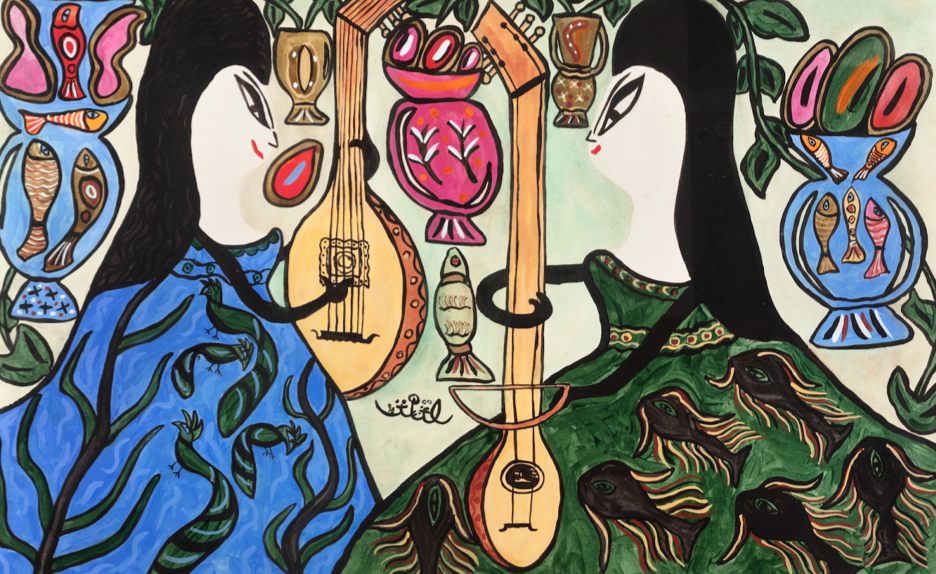
Baya Mahieddine or Baya, also known as Fatma Haddad, is an Algerian artist introduced in Paris in the 1940s after her first solo exhibition in 1947 at the Maeght Gallery. Described by André Breton as a “queen”, and included to the repertoire of Art Brut by Jean Dubuffet, Baya seems to have left her mark on the Parisian art scene of the second half of the 20th century.
Her work follows a very intuitive path: the colourful gouaches, populated with flowers, animals and especially female figures, are inspired by her adoptive mother’s work and the atmosphere she grew up in. She started painting instruments after she married a musician in 1961, and she took further her love for “making soil” in 1948 at a pottery workshop in Vauliers, a year after being introduced in Paris.
Recent research has revealed more layers to her work. First, its part in the construction of artistic modernism in Paris, which is difficult to measure for artists of the MENA region. Secondly, the omnipresence of the female figure in her gouaches appealing for a closer look at her status as a woman artist. These two readings will be presented here as they offer an overview on Baya’s impact as an Algerian woman artist of her time.
Born in Algiers in 1931, Baya was brought up by her grandmother, whom she helped with her work on a colonial horticultural farm. The farm owner’s sister, Marguerite Camina Benhoura, who was also a painter, integrated Baya into the domestic chores and took a liking to the child, whom she eventually adopted in 1942. Baya grew up between Marguerite’s houses in Algiers and South of France, where she was imbued with the visual atmosphere of flowers and birds which inhabits her gouaches, but also in her adoptive mother’s paintings and her collection, including some Braque and Matisse. Marguerite Benhoura received Aimé Maeght in Algiers in 1943 and the gallery owner got interested in Baya’s productions. An exhibition was then devoted to the young artist in 1947 in his gallery in Paris which quite defined her status among the artistic scene of the time.
The Myth of Baya
After this first solo exhibition at the Maeght gallery in 1947, Baya was presented as a child prodigy coming from North Africa. Her “naïve” style fitted Dubuffet’s definition of “Art Brut” as an art by self-taught artists who evolved outside the academic system. Her presence in Paris also coincided with the rising political convictions against colonialism among the parisian art scene. Because she more or less matched those criteria, the painter was perceived as a mythical and inspiring figure whose work was yet limited to an oriental fantasy or an underdog.
It seems, however, that Baya’s impact was much more than just a question of inspiration and her presence in Paris at that time could even put into perspective the construction of artistic modernism. The artist’s own statement regarding this is quite revealing: “At home my mother had Braque and Matisse paintings. These are painters I love, who touch me deeply, but I don’t know if I can say that I was influenced by them. I have the opposite impression: that they borrowed colours from me, for example. Painters who didn’t use Indian pink started to use it. But Indian pink and turquoise blue are Baya’s colours, they have been present in my paintings since the beginning, they are colours that I love“.
Baya has often refused to categorize her work or to claim to be part of any avant-garde movement. Above all, she advocates a personal artistic movement she once called Baya-isme.
A woman painter, a painter of women
Another reading of Baya’s work emphasizes its feminist character: Assia Djebar’s essay entitled « Baya, le regard fleur » sets that the compositions and the piercing eyes of Baya’s female characters in particular, are revealing. For the author, it is a metaphor for the liberation of both the Western and Islamic view of women, North African women in particular:
“Baya’s woman is endowed with a giant eye which, with agape, greedily desires flowers, fruits, the sounds of lutes and guitars, complicit birds, fish in a jar, a child on the head or shoulders of a woman in conversation with a palm tree […] Everything is made flush, flat, rich, moments of “gathering”; everything, except man. He would be the guardian. He would hold the keys. »
This reading of the artist’s work, of which Djebar seems to be the first spokesperson, brings more elements to the understanding of her production. Still, the artist herself does not have all the answers on why this absence of men in her artistic universe, and mostly explains it with a need to remember her mother:
“Indeed, I am often told: – why never men, always women? I think I can answer this question … I lost my parents at a very young age. First my father and then my mother. I remember my father vaguely, but I have a fairly clear picture of my mother despite my young age. In fact, I had drawn a portrait of her: a tall, slim
woman with black hair that fell here. She was really beautiful. I have the impression that this woman I paint is a bit of a reflection of my mother: I make her a musician… »
Baya had this ability to literally translate her own reality into paintings. Her impact on “modern” painting and the Parisian scene is certain but has yet to be defined and precisely traced. It also seems that she had more effect in Paris than she did in Algiers or in the MENA region at her time, but these hypotheses remain to be explored further. She is nonetheless an important Algerian woman artist of her time, currently celebrated in a beautiful exhibition at the Sharjah Art Museum, on until July 2021.
Sources:
- Assia Djebar, « Baya, le regard fleur », Le Nouvel Observateur, January 25, 1985.
- [Exhibition catalogue] Baya, Musée Cantini, Marseilles, 1982, [93p].
- [Exhibition catalogue] Baya: Woman of Algiers, Grey Art Gallery, NYU, 2018, [30 p.].
- “The Algerian Teenager Who painted a World of Liberated Women in 1940s Paris”, Alexxa Gotthardt, fév. 5, 2018, on Artsy.net <https://www.artsy.net/article/artsy-editorial-algerian-teenager-painted-liberated-women-1940s-paris>
- Interview with Dalila Morsly, “Baya parmi nous” in Algérie, Littérature/Action, n°15-16, 1997, Marsa éd., Paris.
Video: (Also mentioned in the first page): “Baya Mahieddine (1931-1998), The young artist who inspired Picasso”, <https://www.dailymotion.com/video/x41nt9j>
