



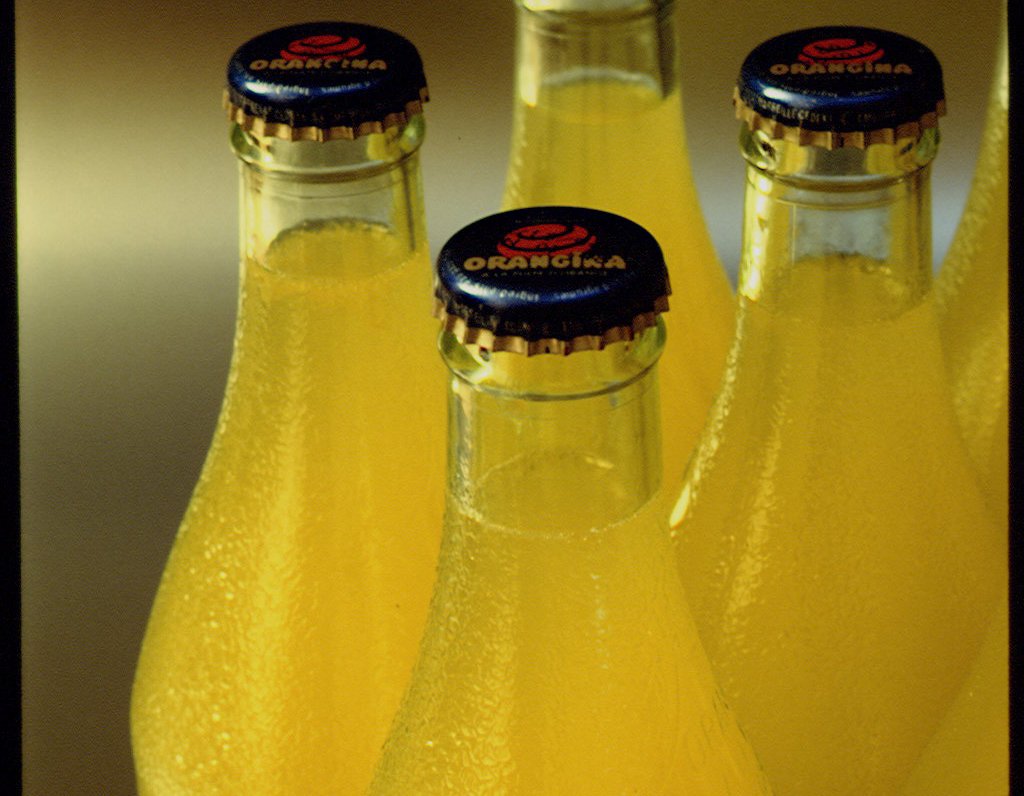
Marketed as the taste of French summer, Orangina’s origins are complicated.
In a sleek advertisement poster designed by the French artist Bernard Villemot in 1953, an orange peel curls in the shape of a parasol against a blue background. It suggests carefree summer skies and the Mediterranean – idealised Frenchness in a bottle. This and 16 subsequent posters – all for Orangina – became some of the most famous creations of Villemot’s distinguished career.
While framed as a quintessentially French drink, however, Orangina’s origins are complicated. In 1933 a Spanish pharmacist and politician, Augustin Trigo Mirallès, invented a citrus-based drink in his hometown of Valencia, which he called Soda de Naranjina. He presented it, in a prototype of the famous orange-shaped bottle, two years later at the International and Colonial Fair in Marseille.
Léon Beton, a Frenchman, owned an orangery close to the Algerian city of Boufarik in the Mitidja Plain, the centre of citrus production in Algeria. The colonial citrus industry was at its height from the 1930s to Algeria’s independence in 1962, and most of the oranges consumed in France came from Algeria. Beton, who was looking for new ways to sell his oranges in France, might have been predisposed towards the commercial opportunities presented by drinks as Algeria had a history of pioneering sodas and lemonades. The company Hamoud Boualem, for instance, founded by the Algerian Youssef Hammoud in 1851, started selling a citrus-based lemonade called La Royale in 1878, making it eight years older than Coca-Cola.
Beton attended the 1935 fair in Marseille and tried Mirallès’ new drink. In its present form it was not immediately drinkable, and Beton first had to mix a spoonful of Naranjina with essential oil, sugar and mineral water. While he knew that the mixing process was not commercially viable, he was thrilled with the drink. Beton returned to Algeria with a business partner and a new idea of how to sell oranges. The following year, with Mirallès’ consent, Beton applied for a patent for an Algerian version of Naranjina that could be consumed straight from the bottle, under the name of Orangina; today, the brand describes 1936 as being the year of its conception.
The Spanish Civil War and Second World War stalled Mirallès and Beton’s plans, but in 1947 Jean-Claude Beton, Léon Beton’s son, took over the family business and rekindled contact with Mirallès. Beton opened his Orangina factory in Boufarik, with the drink being bottled in Blida and Algiers, then founded a company, the Société Naranjina Nord-Afrique, in 1951. The relaunch of Orangina came just as Coca-Cola opened a factory in Algiers in 1949.
Years before this, in the 1920s, Hamoud Boualem had advertised a sweet, orange-based soft drink called Orangine in various North African newspapers. While Orangine was unconnected with Orangina, consumer familiarity with this earlier product might have facilitated the popularity of Beton’s drink. These early Algerian Orangina-drinkers viewed the product as primarily an Algerian drink, produced by Algerian workers.
In the 1950s, Beton tried to conquer the French market and commissioned Villemot’s posters. French people, eager for leisure, sun and joy after the bleak experiences of the Second World War, loved it. In 1954, Beton’s plans were hampered by the outbreak of the Algerian War of Independence. However, according to a legend upheld by the company, French soldiers who came across Orangina in Algeria returned to France with a fondness for it, where their habit was adopted by the French. Very similar stories were told in the 19th century about French soldiers who supposedly returned from their brutal service in Algeria with a love for a new drink which became wildly popular in France: absinthe.
Another reason for Orangina’s success was the French rejection of Coca-Cola. In the 1950s, as Beton was pushing into the French market, there was growing resistance to Coca-Cola and to US influence in France, often referred to as ‘coca-colonisation’. The journalist Robert Escarpit wrote an article, ‘Mourir pour le Coca-Cola’ (‘Die for Coca-Cola’), in Le Monde in 1950, claiming that, since the end of the war, France had silently accepted American ‘chewing gum and [the films of] Cecil B. de Mille, Reader’s Digest and Bebop’, but accepting Coca-Cola was a step too far: ‘Coca-Cola seems to be the Gdansk of European culture.’ The quintessentially French Orangina presented itself as an antidote to this. Orangina’s popularity then spread to other French colonies and neighbouring countries, and, by the mid-1970s, was selling 500 million bottles annually.
Towards the end of the Algerian War of Independence Beton found he was unable to keep the factory in his native city of Boufarik and so in 1962 he moved Orangina’s headquarters to Marseille. Then, in 1963, as part of the wave of nationalisation of property formerly owned by French settlers, the new Algerian state awarded a recently founded company, Orangina Algérie, the rights to Orangina. A few years later, the Société des Eaux Minérales in Saïda also claimed them. Legal disputes continued for 40 years as Beton resisted what he perceived as counterfeiting of his product.
Beton’s French branch of Orangina continued to grow and became international, in ownership as well as sales, when it was acquired by Pernod Ricard in 1984, by Cadbury Schweppes in 2000, by Lion Capital and Blackstone in 2006 and, finally, by Suntory in 2009. In 2003, Orangina returned to Algeria with the opening of a new factory. Yet because of Orangina’s self-portrayal as quintessentially French and thanks to the long-drawn legal battle between Orangina, Orangina Algérie and the Société des Eaux Minérales, the drink’s former popularity could never be restored in its country of origin.
Nina Studer is a historian of the colonial Maghreb and is writing a history of absinthe.
Source : https://www.historytoday.com/archive/history-matters/pulp-fiction
