



President Macron knows the killing isn’t ‘inexplicable’, but until France acknowledges institutional racism, nothing will change.

This week, French police brutally killed a 17-year-old in broad daylight during a traffic stop. Police initially lied and accused the youth of trying to run over an officer. And, as is often the case, national media reported police fabrications as facts — until cell phone video from a bystander showed the devastating truth.
By now, people across the globe have seen the horrific images of French police brandishing rifles and menacing the occupants of a yellow vehicle in the Parisian suburb of Nanterre before summarily executing the teenage driver with a bullet to the head as he pulled away. Contrary to false claims by the police, no officer was standing in front of the car or physically threatened by the youth driving away.
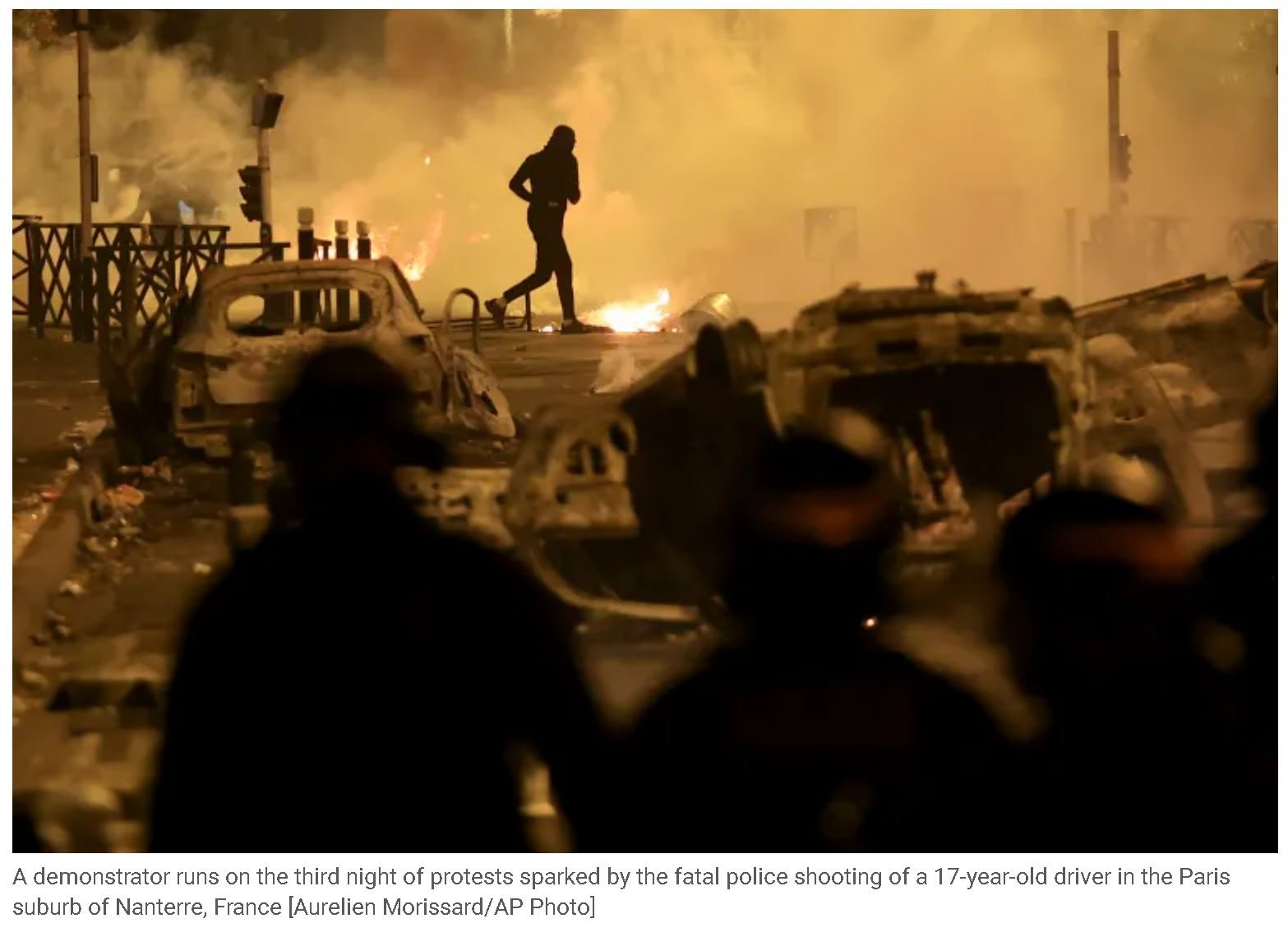
Images of the shooting have produced what the classical French sociologist Émile Durkheim would call a “shock to the collective conscience”. Protests have erupted across the country, only to be met with the deployment of thousands of police officers, tear gas and promises to restore “public order”.
Unfortunately, it comes as no surprise that Nahel, the French teen whose life was cut tragically short by police, was of Algerian ancestry.
France has a long and sordid history of colonial racism and violence against people racialised as “non-white”, stretching from Haiti, Guadeloupe and Martinique in the Caribbean to Réunion Island in the Indian Ocean, North and West Africa as well as Vietnam, among many other populations. France has ruthlessly oppressed Algerian people in particular – including those who are French citizens.
Indeed, French colonisation of Algeria dates back to the early 1800s and involved the widespread use of brutal violence and mass killings to establish French rule.
During the Algerian war for independence (1954-1962), hundreds of thousands and possibly more than 1 million Algerian people were slaughtered and systematically tortured by the French regime in a desperate attempt to maintain their colonial empire in the name of “liberté, egalité et fraternité”— freedom, equality and brotherhood.
Police violence has also historically targeted Arab and Black people in France. In 1961, French police killed more than 100 French Arabs who were peacefully protesting in Paris.
Tens of thousands of people had been marching in support of Algerian independence and in protest against a curfew that had been imposed to quell dissent. In response, police killed French Algerians in the streets, even drowning protesters in the river Seine. The youngest documented death was that of another teenager —15-year-old Fatima Beda. In an era well before smart phones, French authorities engaged in a brazen and largely successful cover-up that lasted for decades. It took more than 50 years for a French president to even acknowledge what happened. Even now, there’s been no official apology.
The historical context of colonial racism and policing that led to the killing of Nahel in Nanterre is largely absent from dominant accounts from white French politicians and media pundits alike.
White French people in particular are more comfortable interpreting the execution of a French North African youth in 2023 as resulting from intractable problems of immigration and poverty in the suburbs (known as the “banlieues”) or the consequence of one poorly trained police officer pulling the trigger – the proverbial “bad apple”.
In the wake of massive protests, French President Emmanuel Macron called the killing “inexplicable”. But this, too, is yet another French fabrication and a form of persistent denial. Nahel’s death is not an unsolvable mystery – it was the result of systemic racism.
Studies have long demonstrated extensive racial bias in French policing targeting Arab and Black people in particular. In 2020, France’s own human rights ombudsperson found that young men who are racialised as Arab or Black are 20 times more likely to be profiled and stopped by police.
The European Commission against Racism and Intolerance has long warned of racial discrimination perpetrated by French police, and communities on the ground frequently acknowledge the heavy toll of being demonised and harassed as a result of racist ideology. The names of racialised minorities who have fallen victim to police violence in France over the past two decades— Zyed and Bouna, Adama Traoré, Théo, among others—have left an anguished record of police impunity.
When these kinds of police killings happen in the United States, as they so frequently do, there is often generally acknowledgement in the media and among liberals and leftists that racism is a fundamental cause.
In France, liberals and leftists often join forces with right-wing extremists to deny the existence of French racism. In fact, as I argue in my book Resurrecting Slavery: Racial Legacies and White Supremacy in France, the global reputation of the United States as an especially racist society is a key factor that enables France and other European nations to minimize and deny their own racial bigotry and discrimination.
Many prominent African American writers and intellectuals who moved to France during the early to mid-20th century also fuelled the myth of French colorblindness. James Baldwin was a notable exception to the rule. Reflecting on his experience in France, he wrote: “I lived mainly among les misérables — and, in Paris, les misérables [were] Algerian.”
Today, the miserable ones, those who find themselves targeted by racism, Islamophobia and police rifles, are still Algerian.
The time has come for France to move beyond the familiar cycle of state violence and denial to an honest acknowledgement of systemic racism as well as a commitment to implementing policies to address widespread discrimination and biases in policing, employment, education and politics.
The real violence at stake isn’t merely the burning of buildings and destruction of property — it’s the very real human cost of victims like Nahel adding to the body count produced by centuries of French oppression.
The views expressed in this article are the author’s own and do not necessarily reflect Al Jazeera’s editorial stance.
